19-26 April 1943

Overview

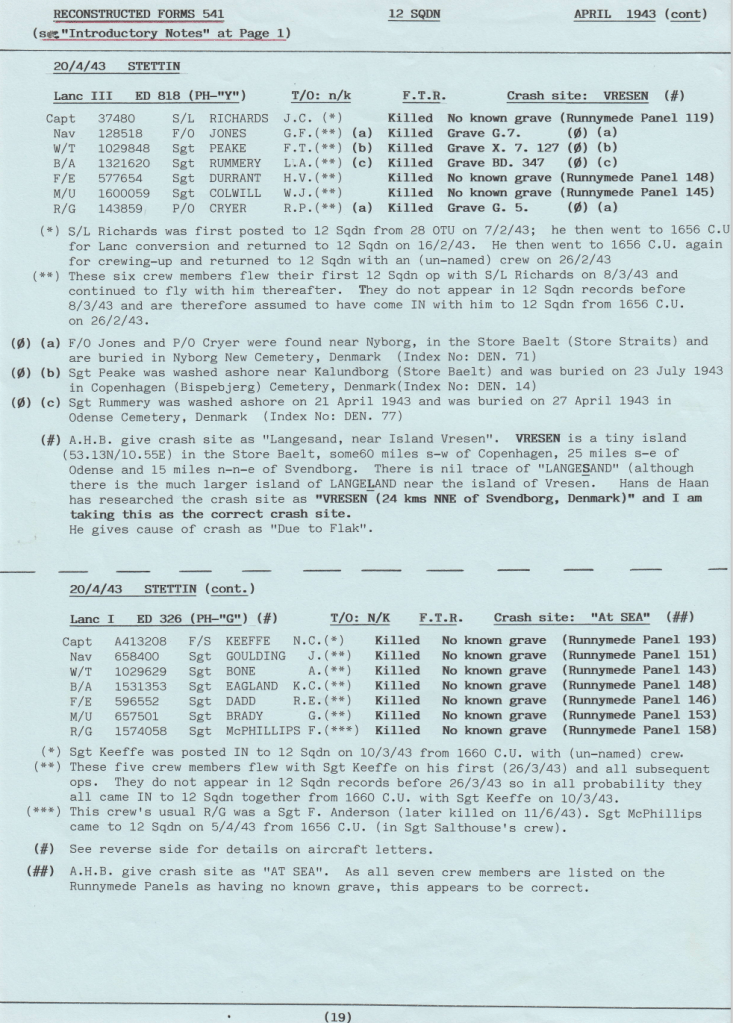
The Battle of the Ruhr was still in full swing and 12 Sqn took part in two large attacks in this week in 1943, to Stettin (now Szczecin) in what was then Germany but is now part of Poland and Duisburg, which is part of the Ruhr area of Germany. The raid on Stettin, more than 600 miles from England, was one of the most successful raids of the Battle of the Ruhr with the Pathfinders carrying out perfect marking on the aiming point. Over 100 acres of the centre were devastated.

Two aircraft and all their crews were lost on the Stettin attack. As you will see below, both these crews were killed on or before their 5th mission. This was considered to be the most dangerous time for new crews.
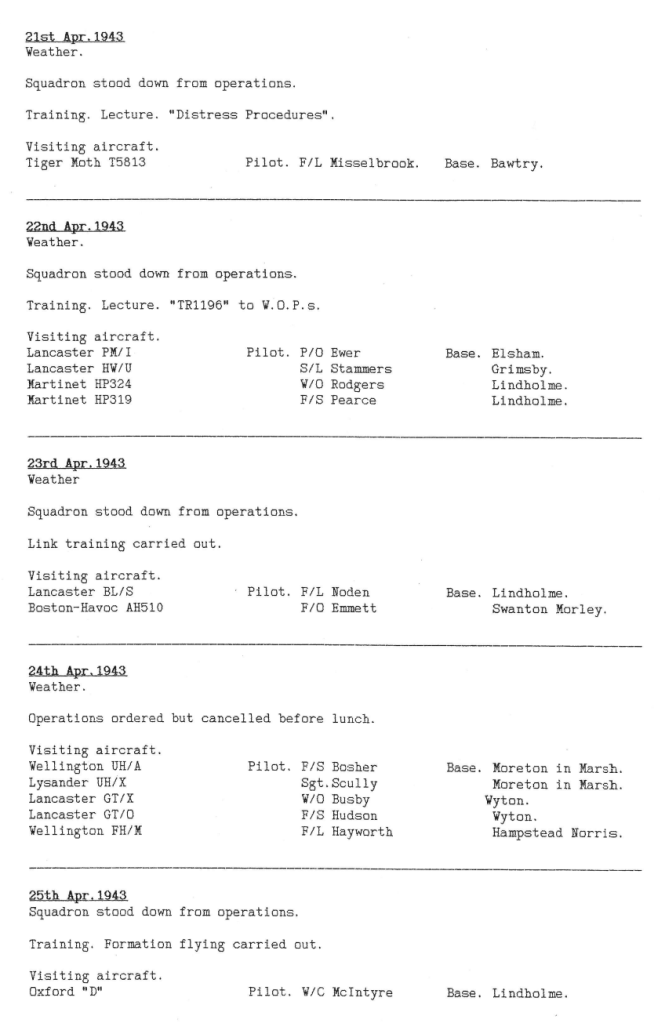
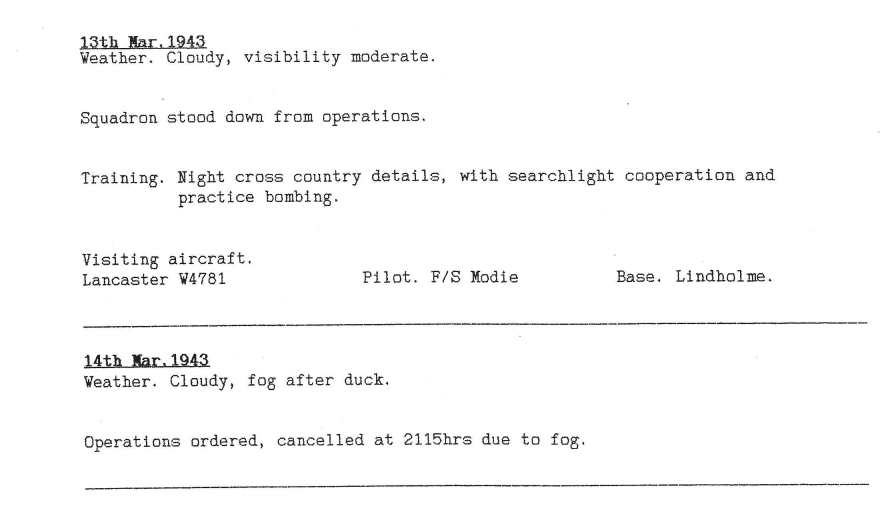
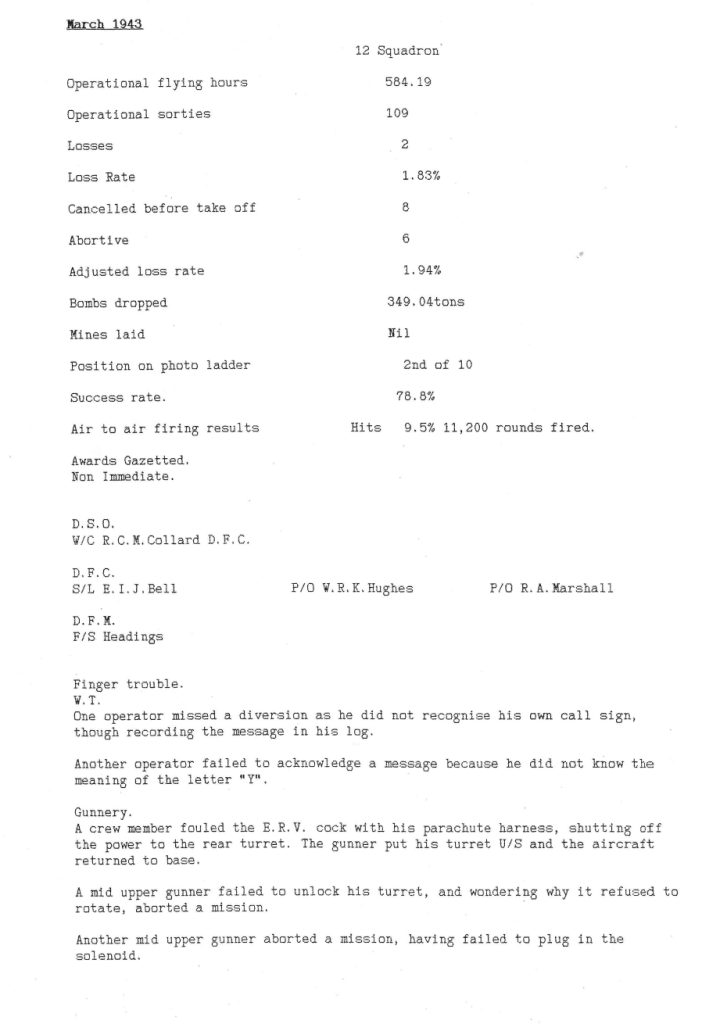
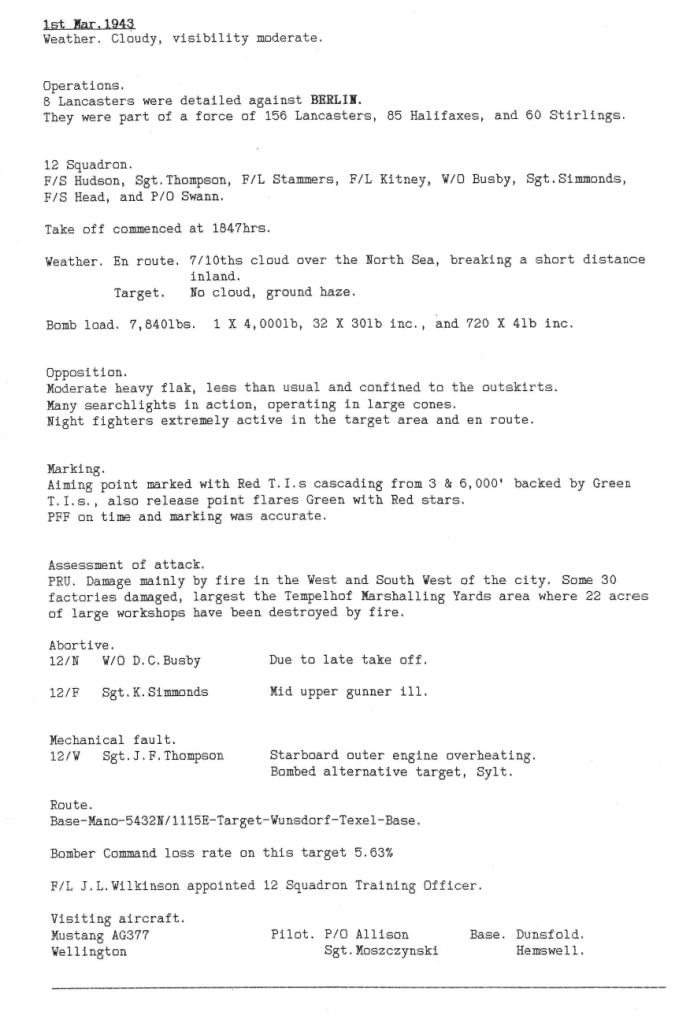
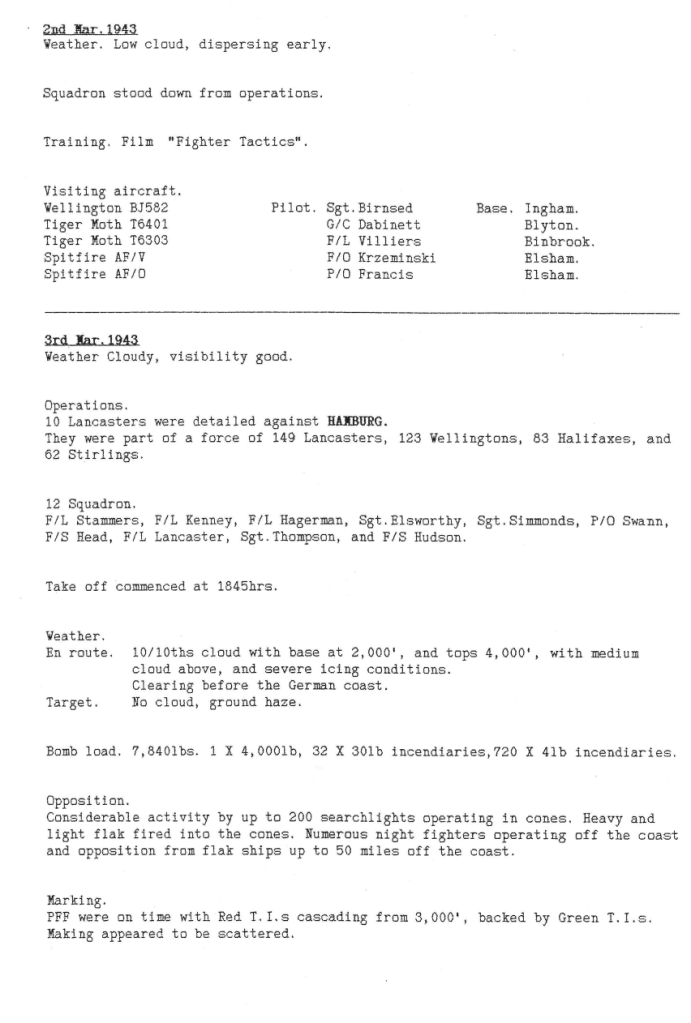
Extract from Station Diary

Sqn Ldr John Richards was an RAF regular who joined in December 1936. Prior to his posting to Wickenby he was a flying instructor in South Africa. He and his crew were killed on their 5th mission.

Flight Sergeant Norbert Keefe was 20 and was a member of the Royal Australian Air Force. He was the son of William Andrew & Elizabeth Colista Keefe of Kensington, New South Wales, Australia. He and his crew were killed on their 4th mission.

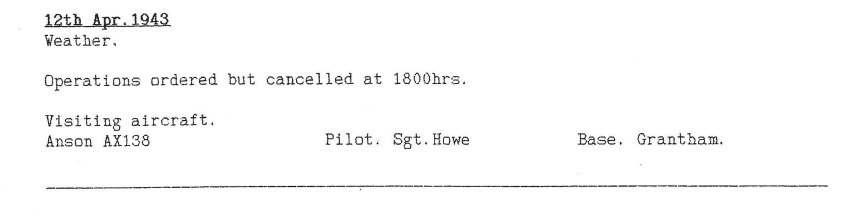
Extract from Appendix to 12 Sqn Operational Record Book
12-18 April 1943

Overview

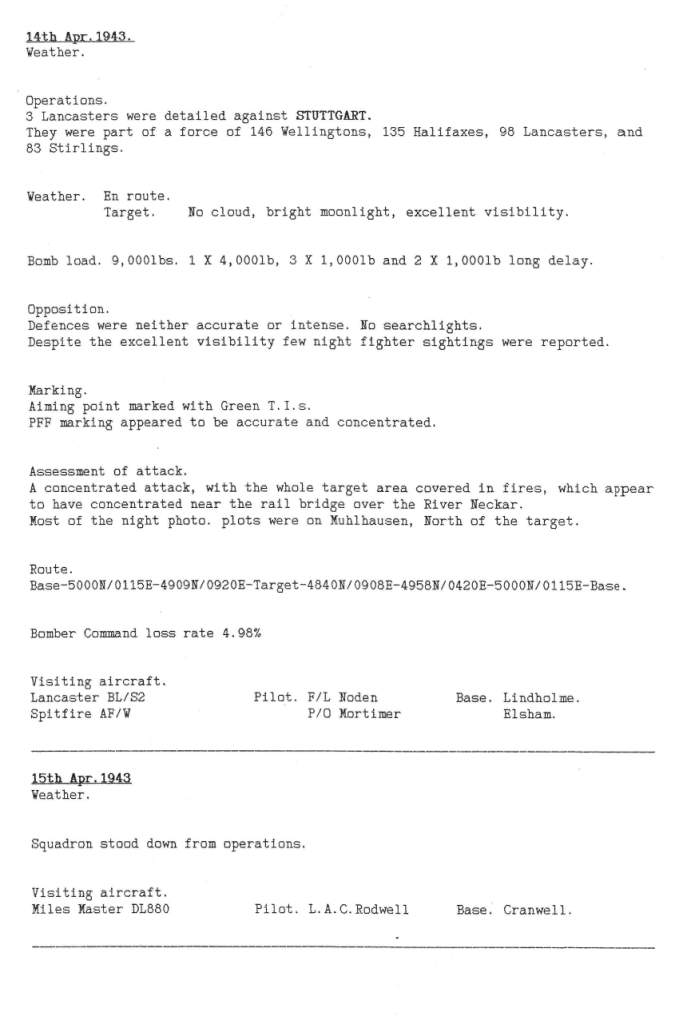
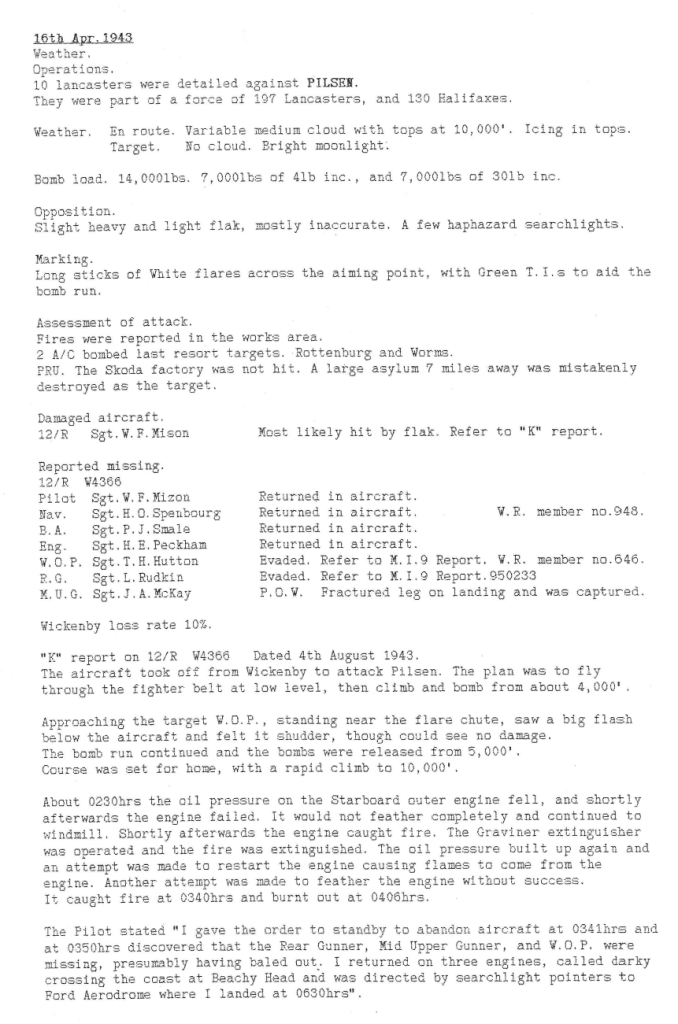
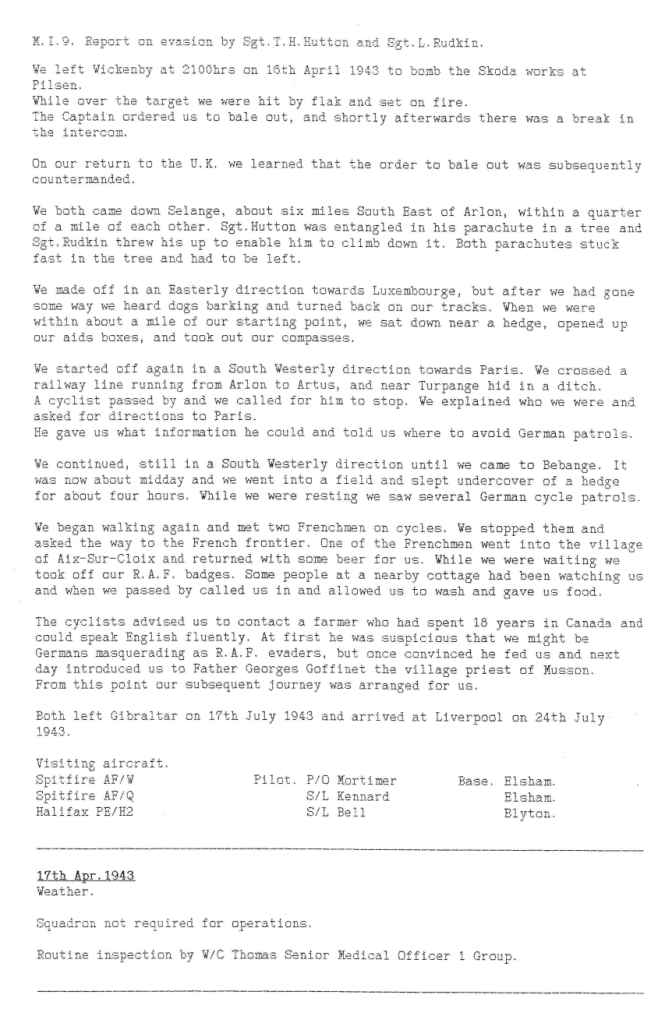
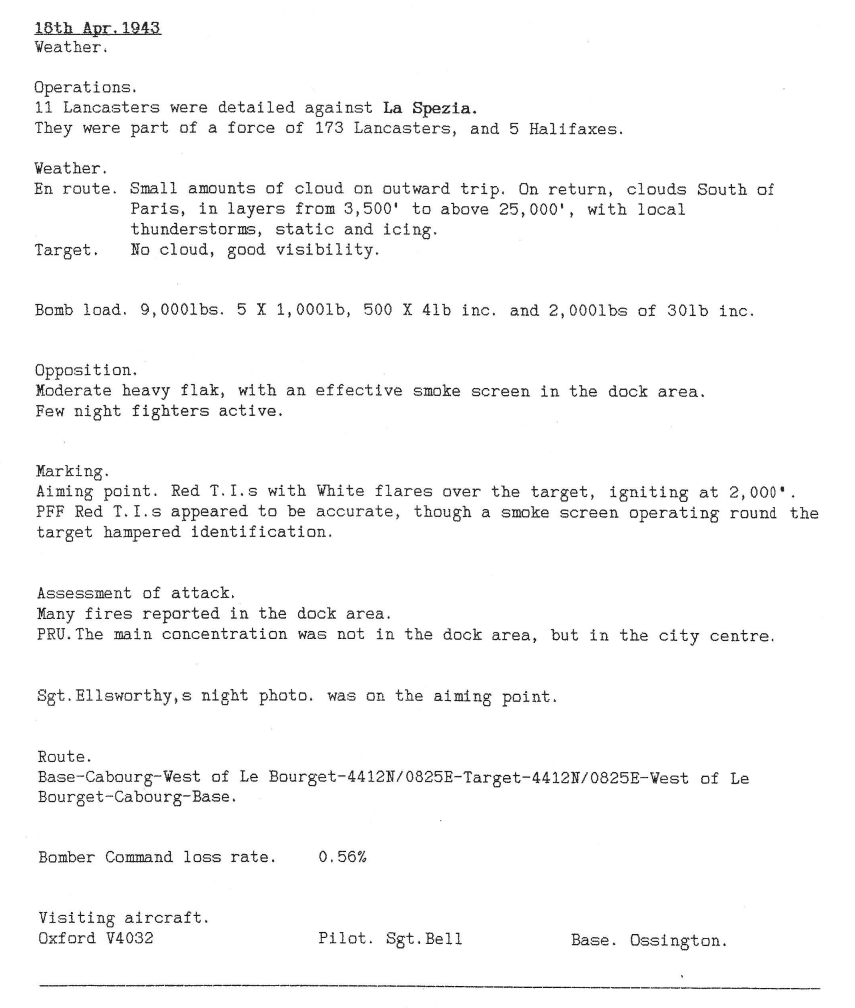
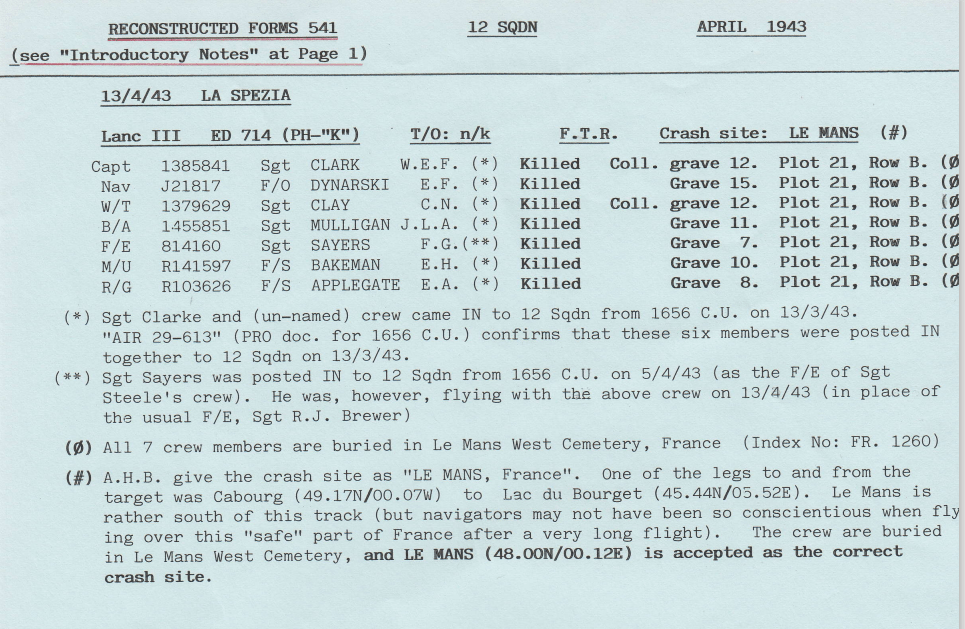
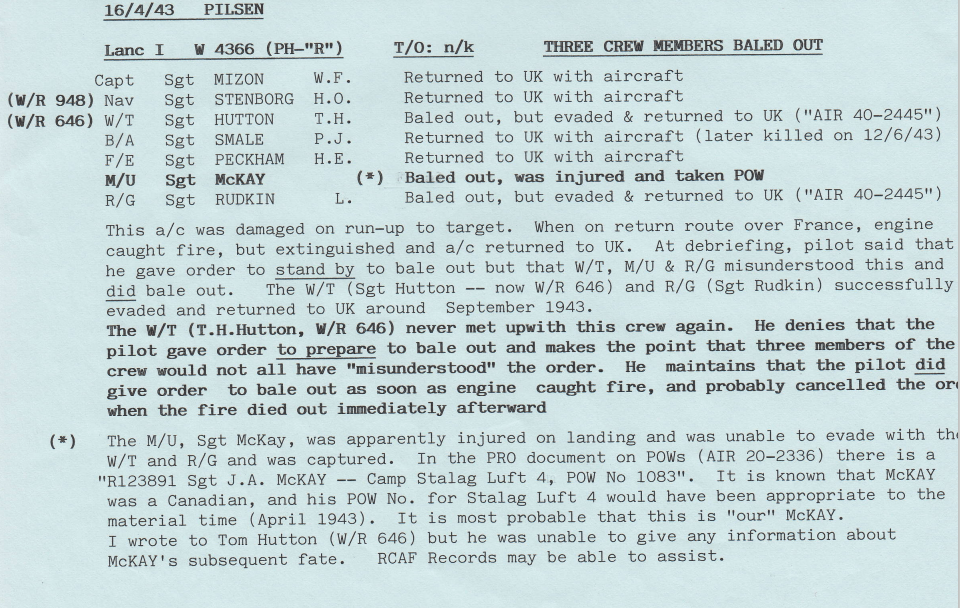
A week that demonstrates the variety of targets and locations attacked by Bomber Command – Stuttgart, La Spezia in Italy and the Skoda factory in Pilsen (Czech Republic). One aircraft and crew were lost in the operation to La Spezia and 3 aircrew bailed out from an aircraft during the attack on Pilsen, although the aircraft and the rest of the crew landed successfully at Wickenby – 2 evaded capture and made it to Gibraltar, the third became a POW due to a broken leg on landing. This crew were on their first mission and there was an order to bail out but it was later countermanded. Their stories are told in the annex to the Station Diary below.

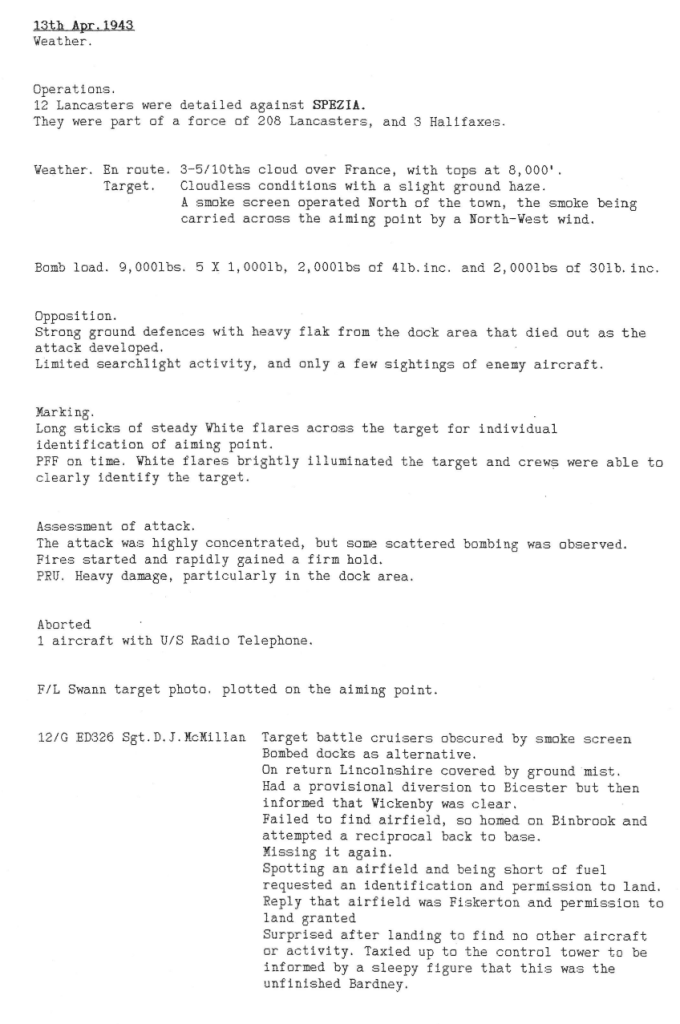
Extract from Station Diary

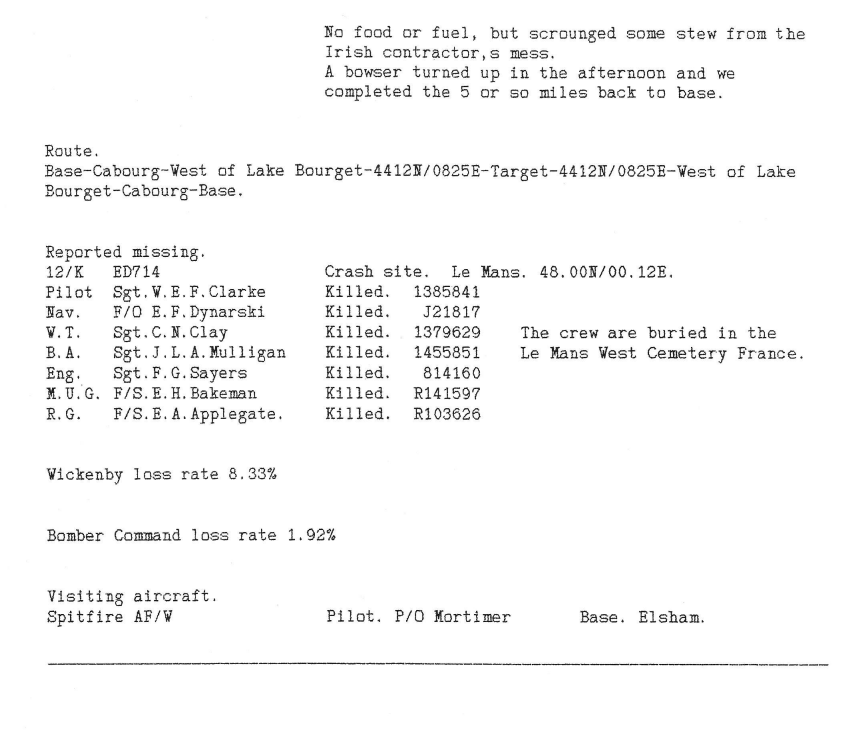
Extract from Appendix to 12 Sqn Operational Record Book

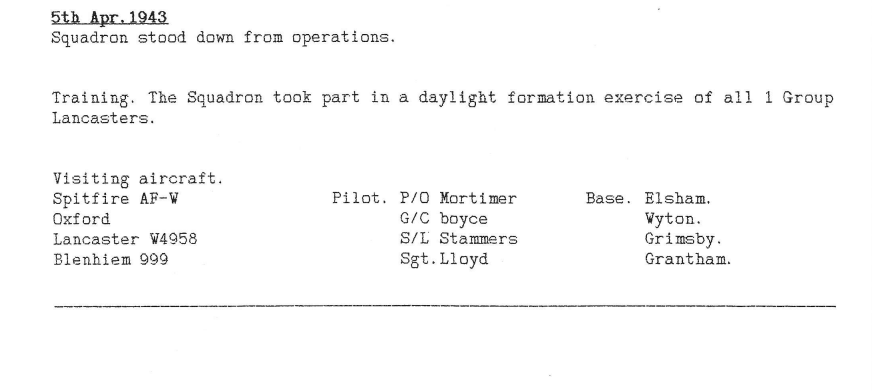
5-11 April 1943

Overview

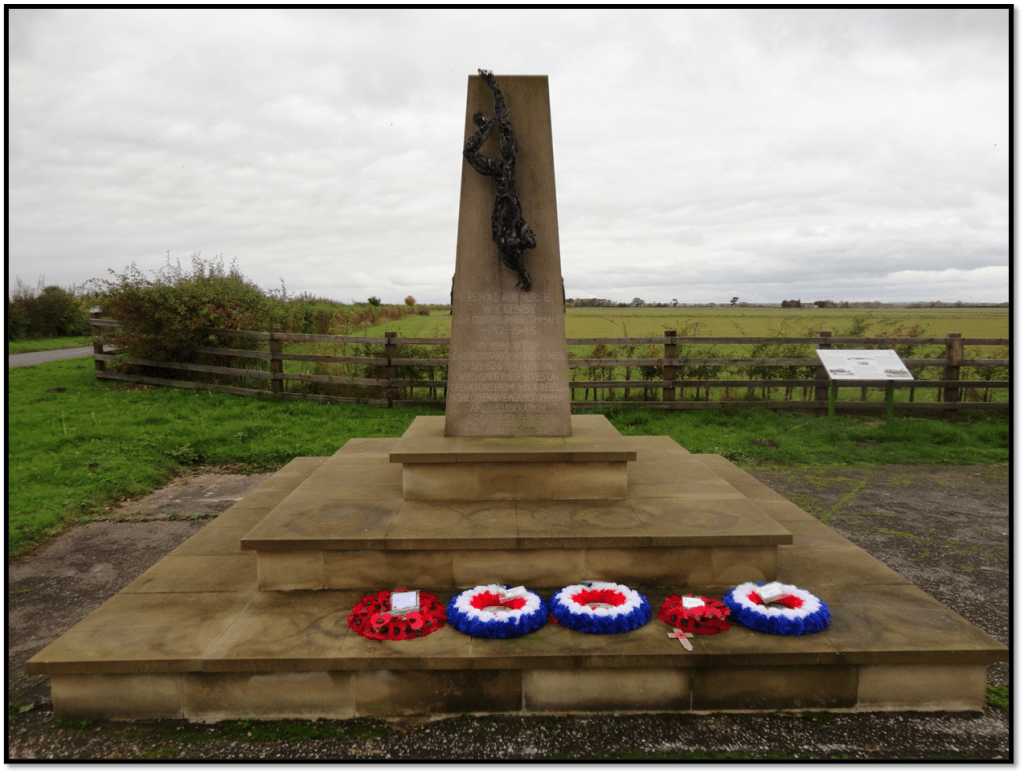
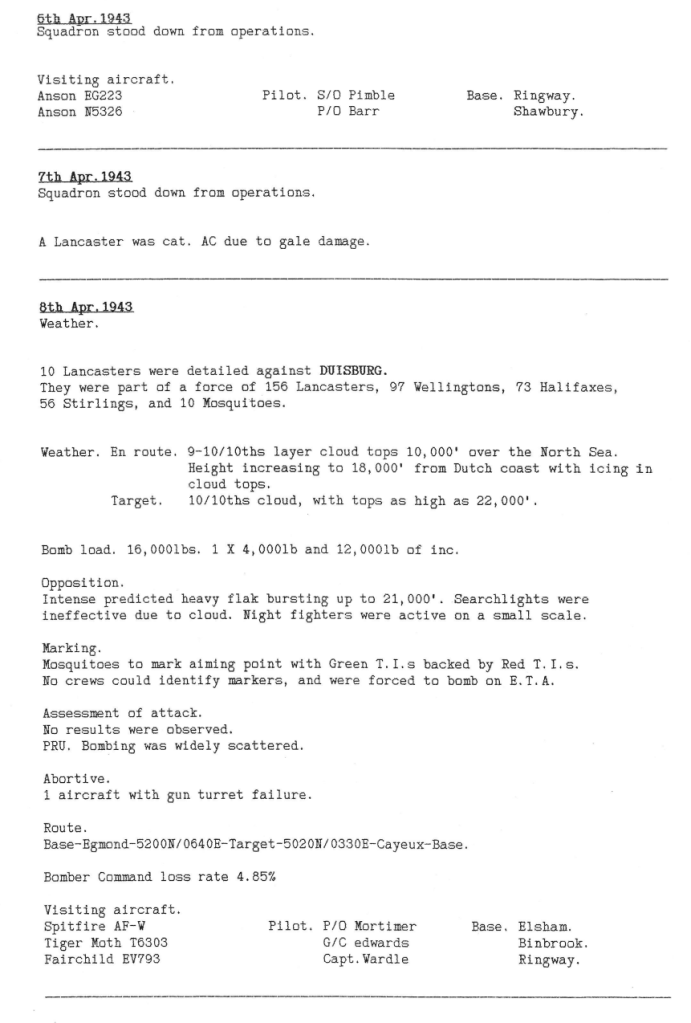
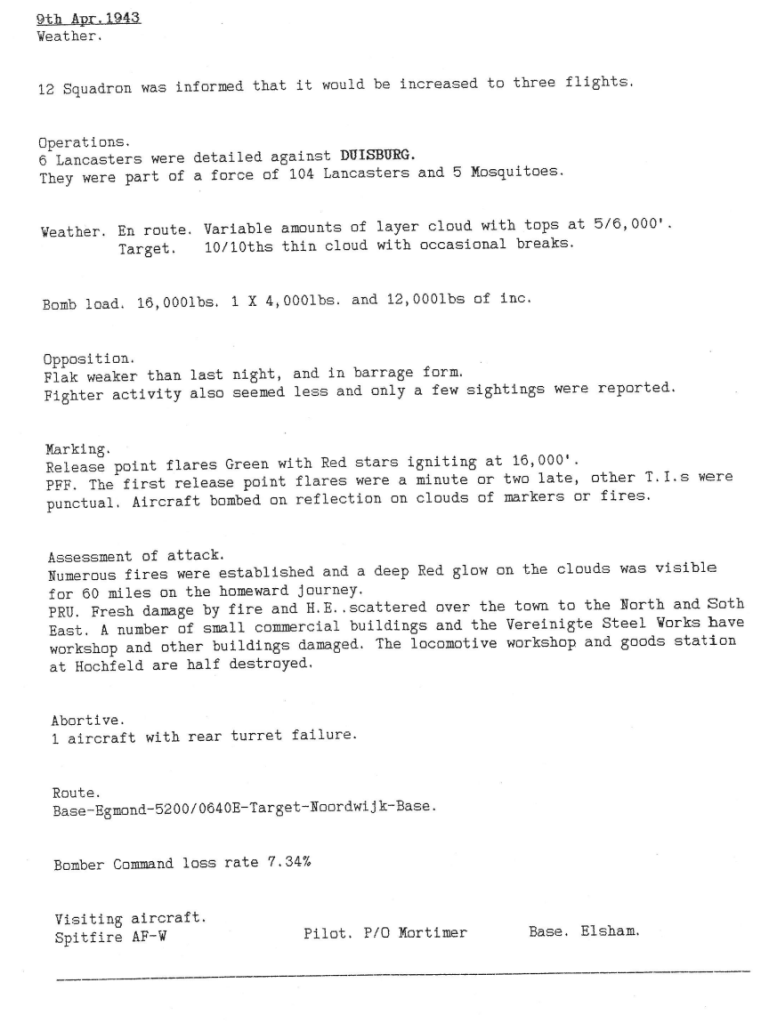
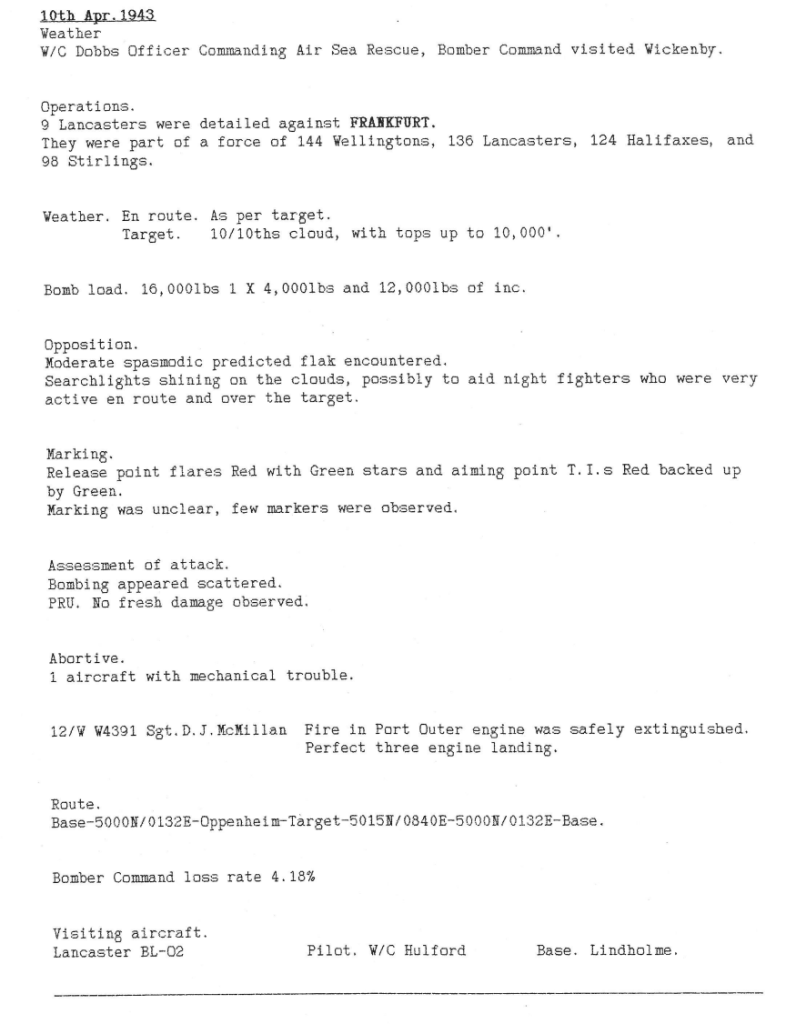
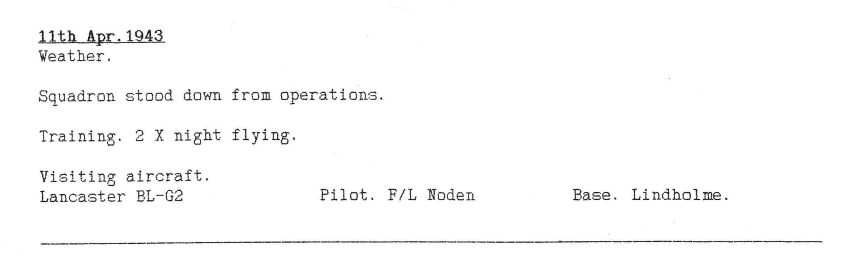
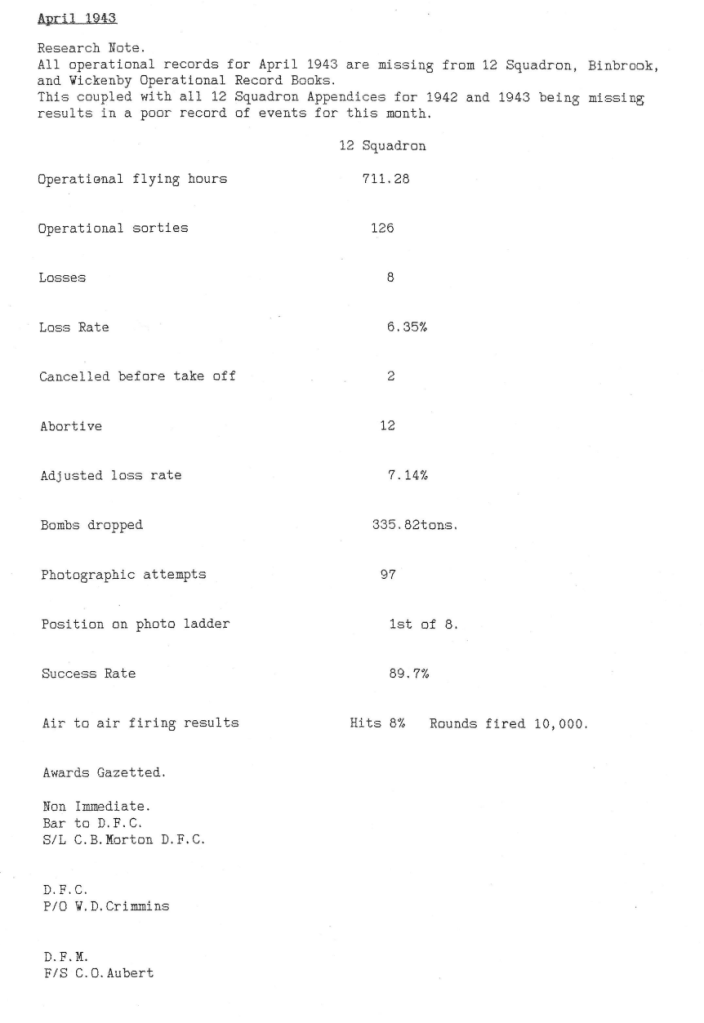
As stated previously, the records for 12 Sqn and RAF Wickenby for April 1943 are missing from the National Archives, so the information I will be showing for this month are not as comprehensive as we would wish. Those that do appear were put together by members of the Wickenby Register, an association of ex-aircrew who did research in the National Archives and spoke to surviving aircrew during the 1980’s. They had annual reunions and paid for the memorial at the main gate of Wickenby Aerodrome and paid for the book of remembrance that is kept in the museum and contains the names of all 12 and 626 Sqn personnel who died in WW2.

The Icarus memorial at the Wickenby Aerodrome main gate

12 Sqn took part in 3 operation this week on three consecutive nights, 8,9 and 10th April, to Duisburg twice and then Frankfurt – there were no casualties. The attack on Frankfurt was through complete cloud cover and led to a failure. Bombing photos showed only cloud and Bomber Command had no idea where the bombs had fallen.

Extract from Station Diary

29 March – 4 April 1943

Overview

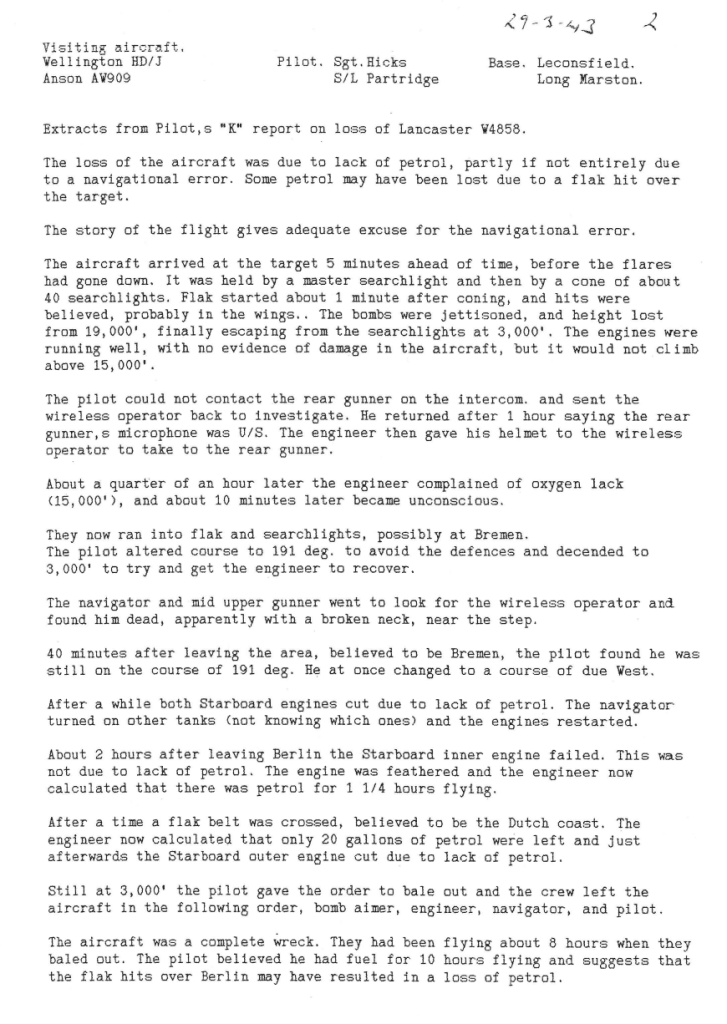
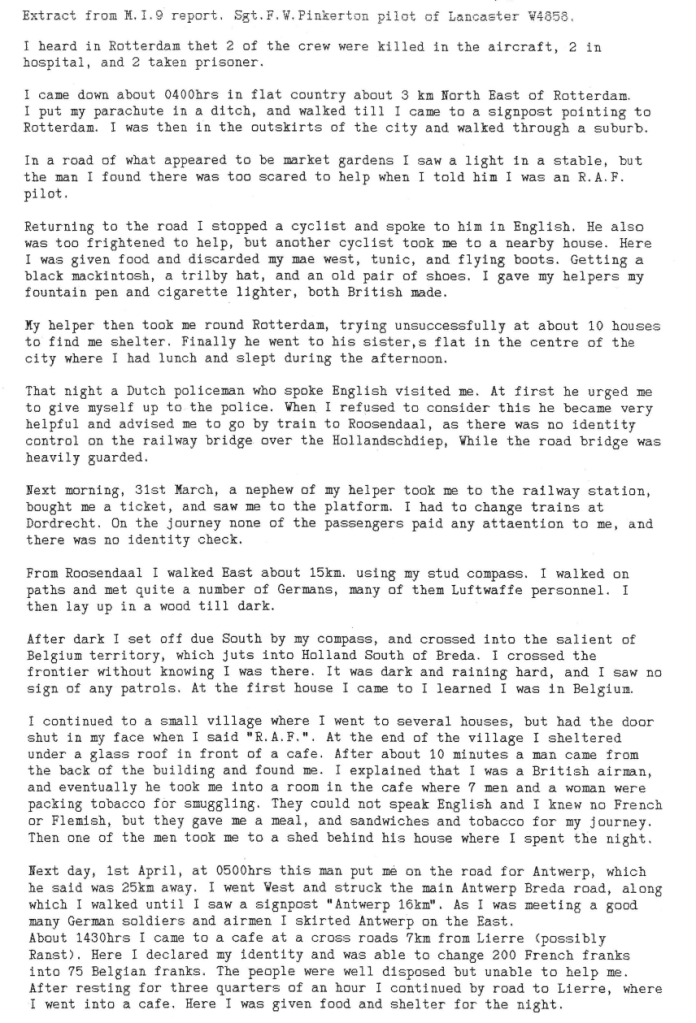
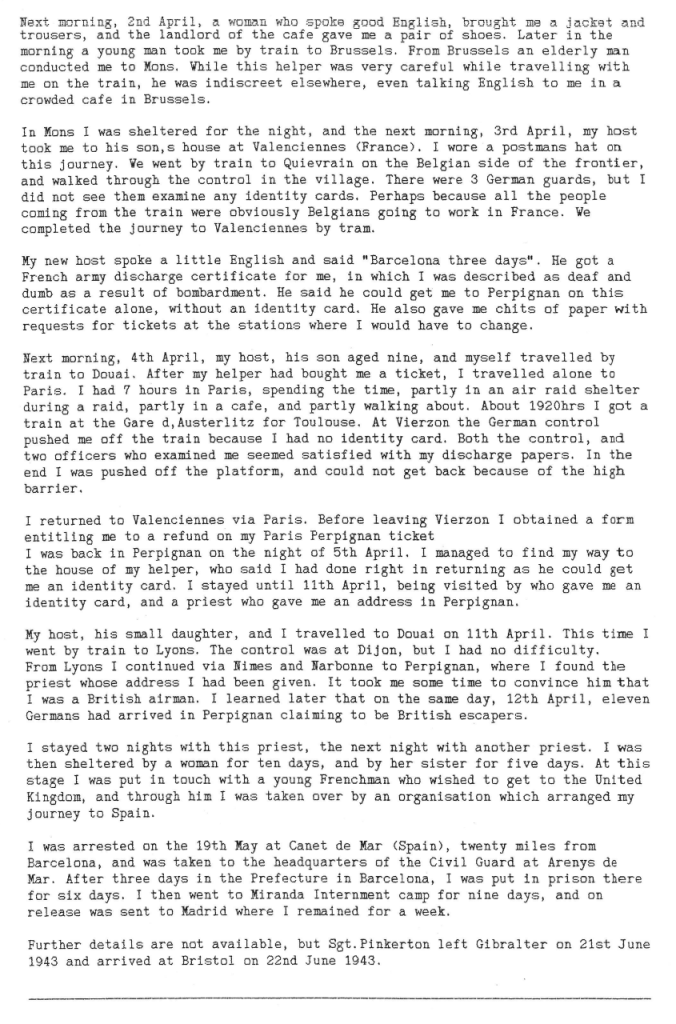
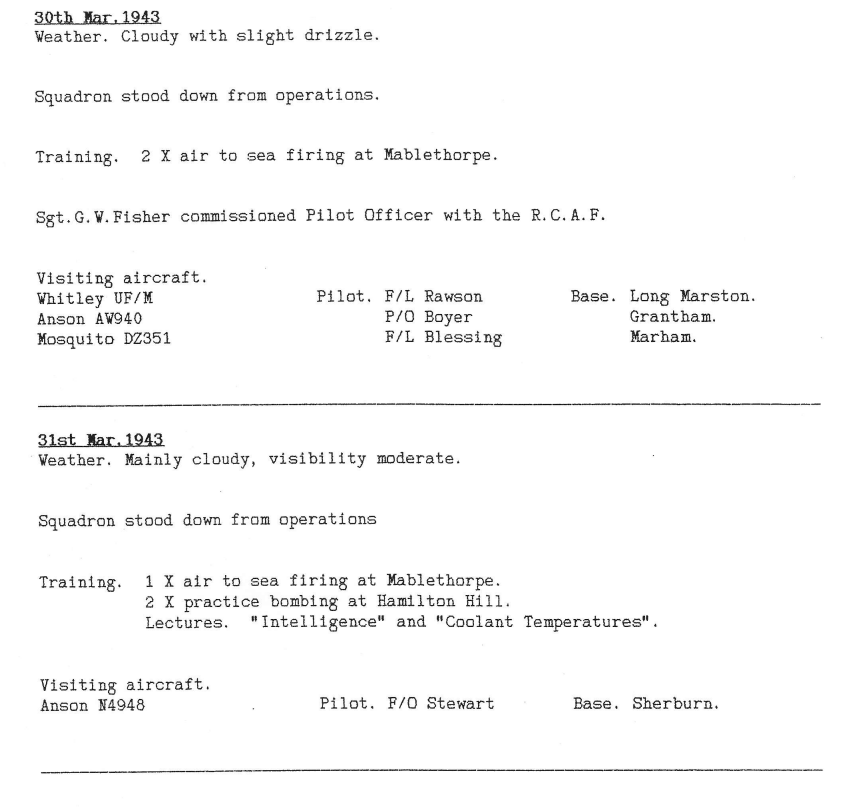
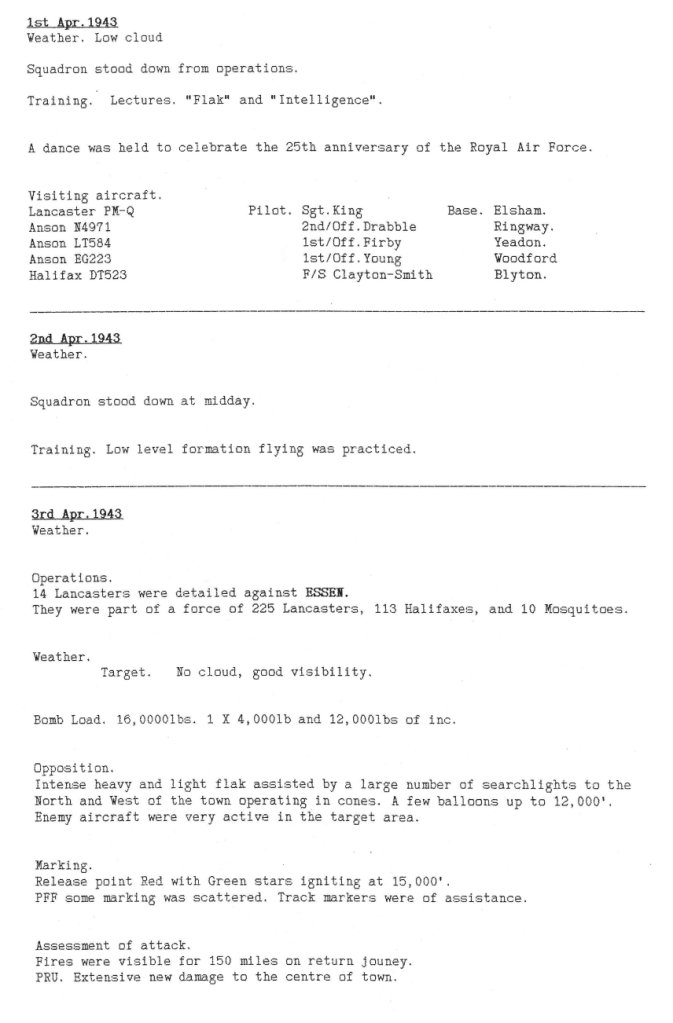
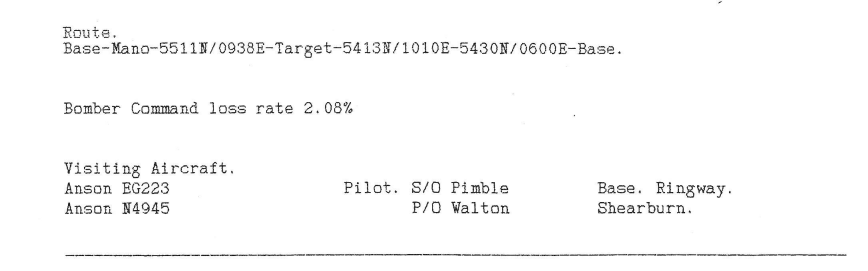
The Battle of the Ruhr was still in full swing and 12 Sqn took part in 3 operations this week, to Berlin, Essen and Kiel. One aircraft was lost in the attack on Berlin. The account written by Sgt Pinkerton, the pilot of the aircraft lost, who managed to evade capture and reach Gibraltar, not only shows the determination and character of Bomber Command aircrew, but also the courage and ingenuity of ordinary members of the public in the occupied countries of Western Europe at that time. Also of note is that the operational records for 12 Sqn for the month of April are missing from the National Archives therefore some of the information is sparse for that month.

Extract from Station Diary

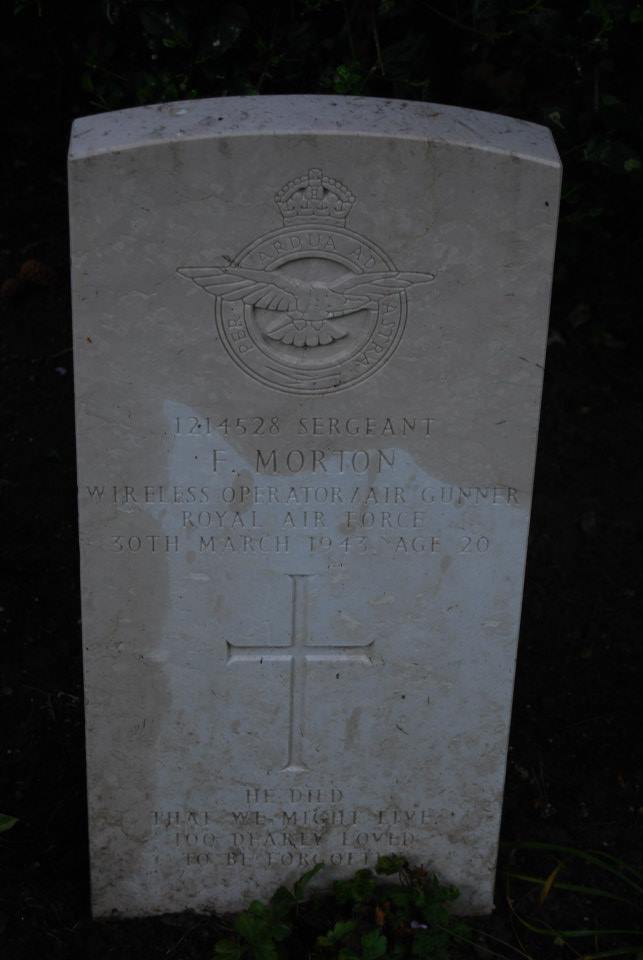
The grave of Sgt Frank Morton, the Wireless Operator/Air Gunner in Sgt Pinkerton’s crew. He was aged 20 and the son of William & Elsie May Morton of Sheffield

Extract from the Appendix to the 12 Sqn Operational Record Book

22-28 March 1943

Overview

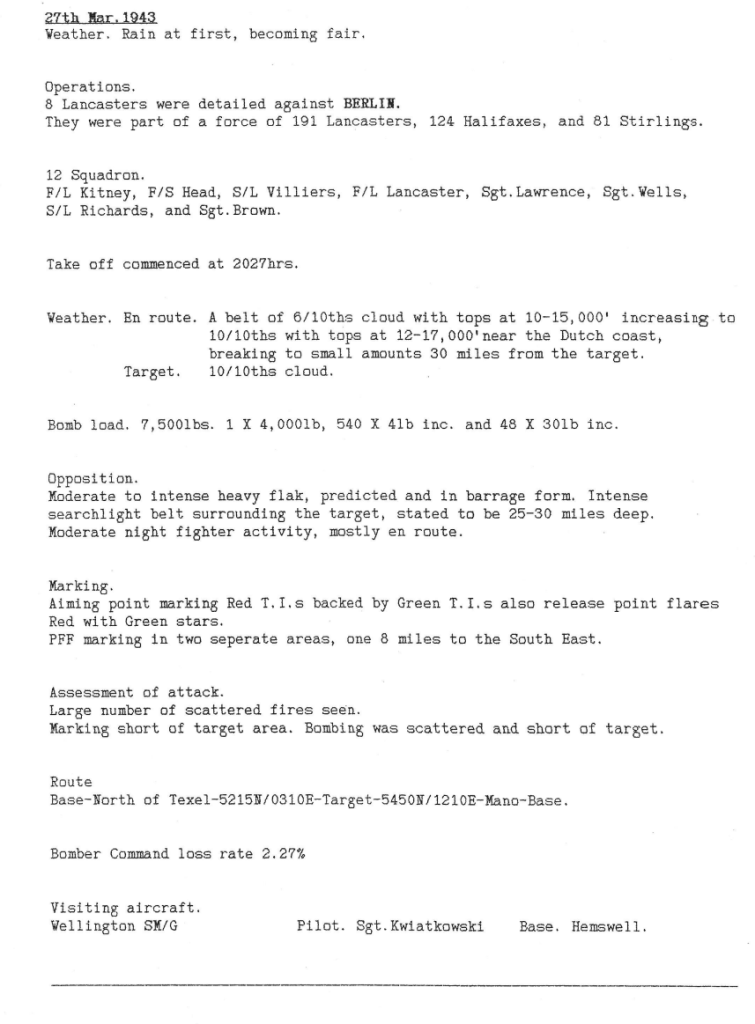
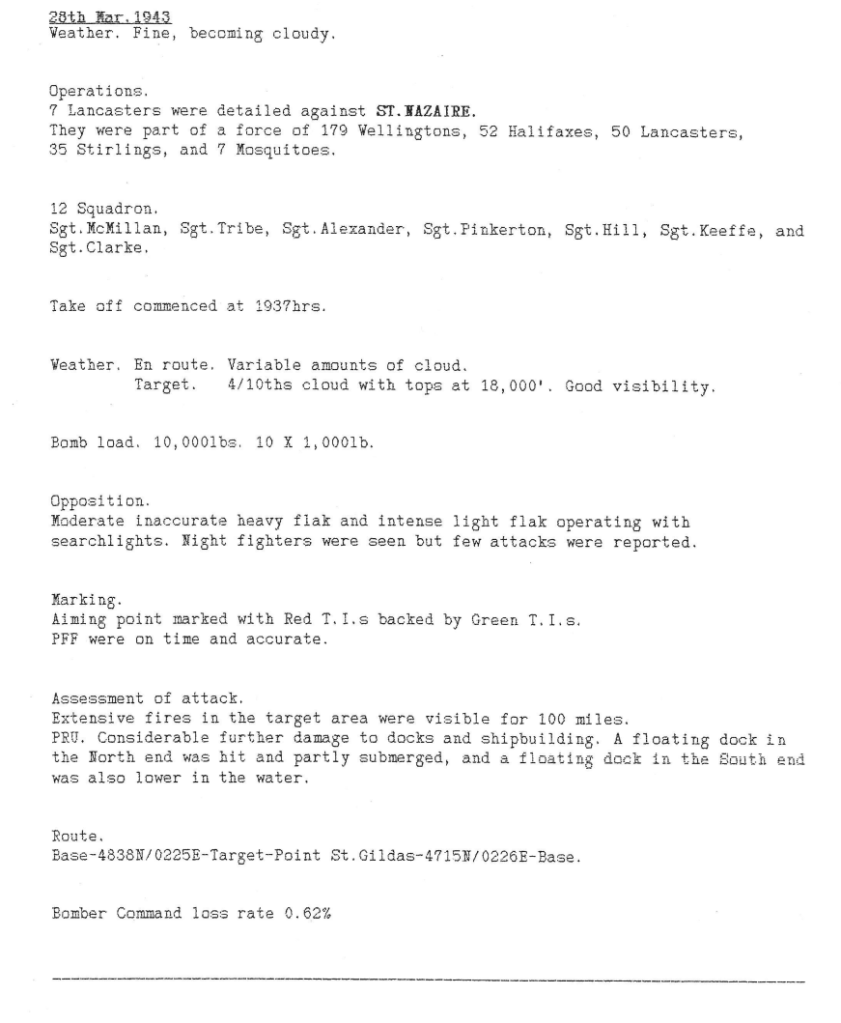
During this week, 12 Sqn took part in 3 operations to Duisburg, Berlin and St Nazaire – no aircraft were lost.

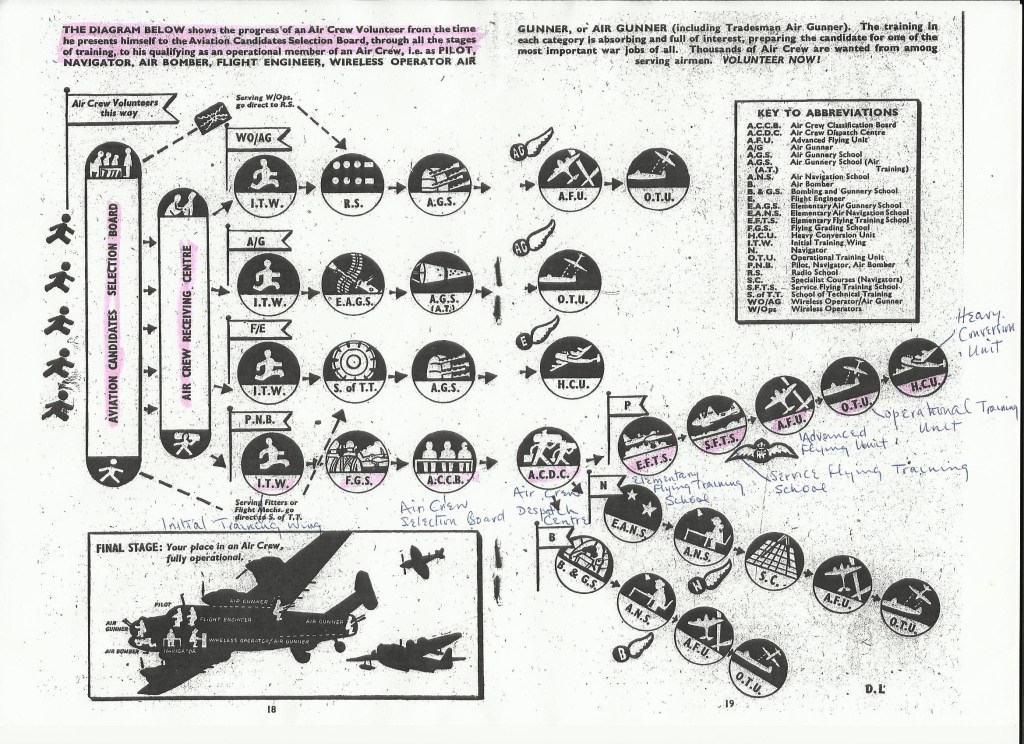
It may be of interest to know the sequence each of the aircrew followed during their training and this chart, produced during the war, gives an outline. Most pilots, navigators and bomb aimers did their main training in either the USA, Canada, South Africa, and some Australians were trained in their home country before sailing to the UK.

Extract from Station Diary

15-21 March 1943

Overview

A quiet flying week for 12 Sqn, who flew no missions and, in fact, for the whole of Bomber Command, the largest attack being 16 Mosquitoes attacking railway workshops in Paderborn. The only event of note at Wickenby was the departure of the last Wellington, being collected by the Air Transport Auxiliary (ATA) for delivery to 33 MU. Unfortunately, the port engine cut and the aircraft crashed, injuring 2 of the ATA crew.

The Air Transport Auxiliary (ATA) was a British civilian organisation set up at the start of the Second World War with headquarters at White Waltham Airfield in Berkshire. The ATA ferried new, repaired and damaged military aircraft between factories, assembly plants, transatlantic delivery points, maintenance units (MUs), scrapyards, and active service squadrons and airfields, but not to naval aircraft carriers. It also flew service personnel on urgent duty from one place to another and performed some air ambulance work. Notably, around 10% of its pilots were women, and from 1943 they received equal pay to their male colleagues, a first for the British government. (Wikipedia)

Extract from Station Diary

8-14 March 1943

Overview

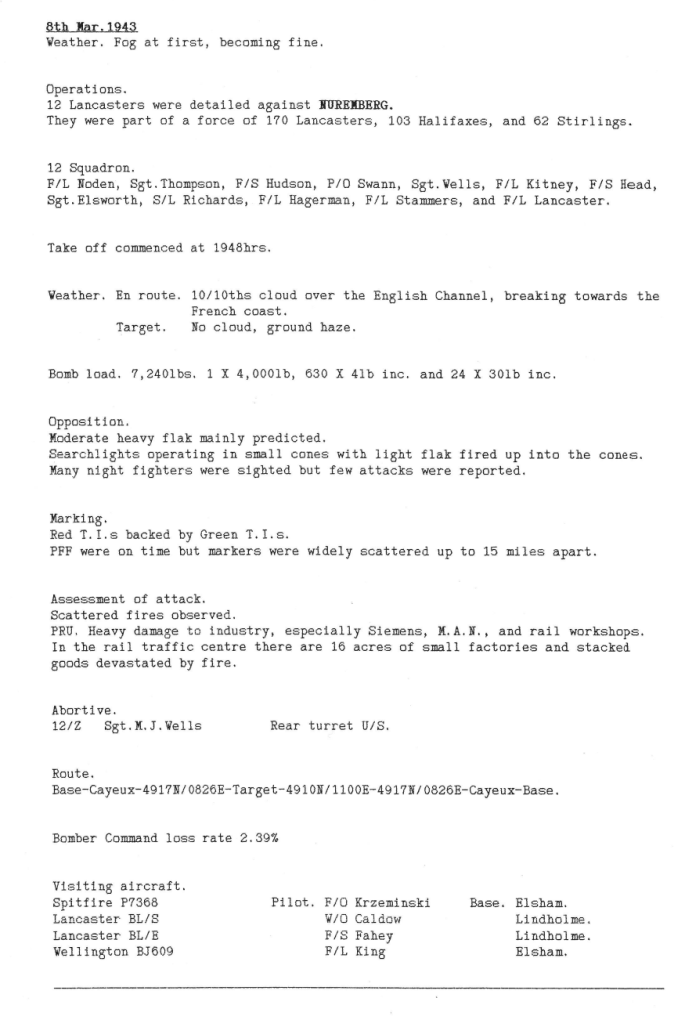
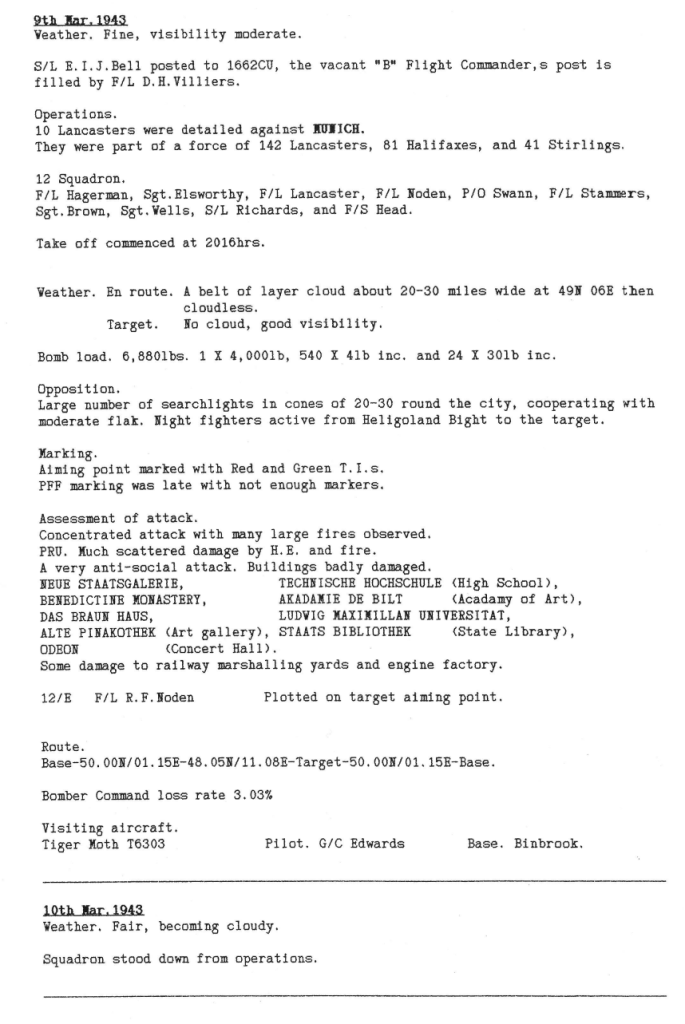
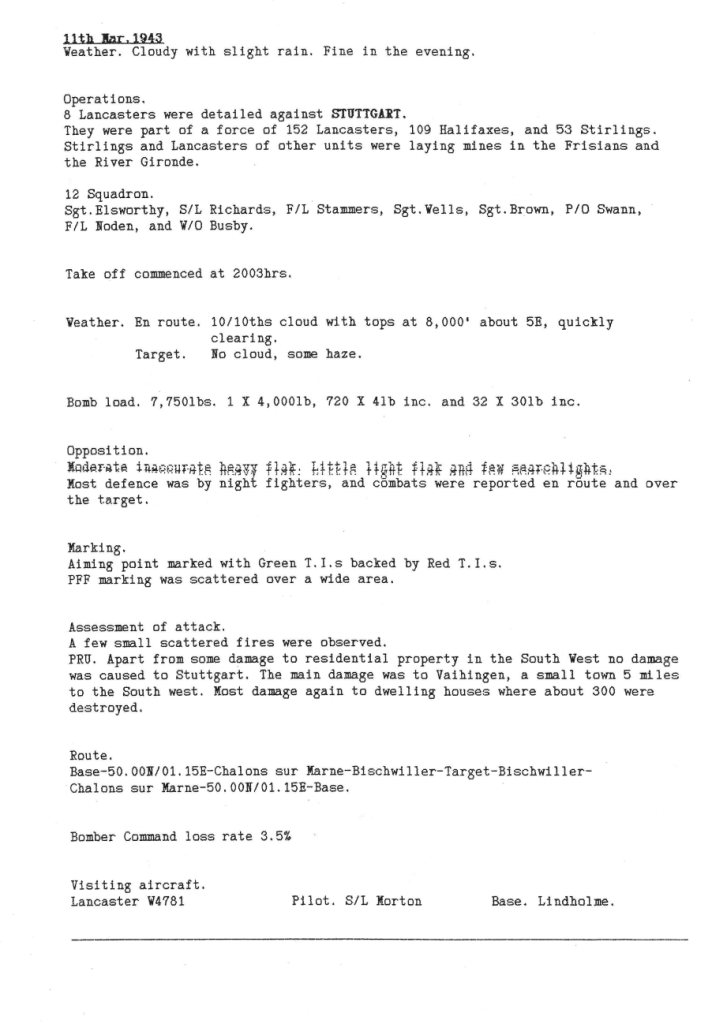
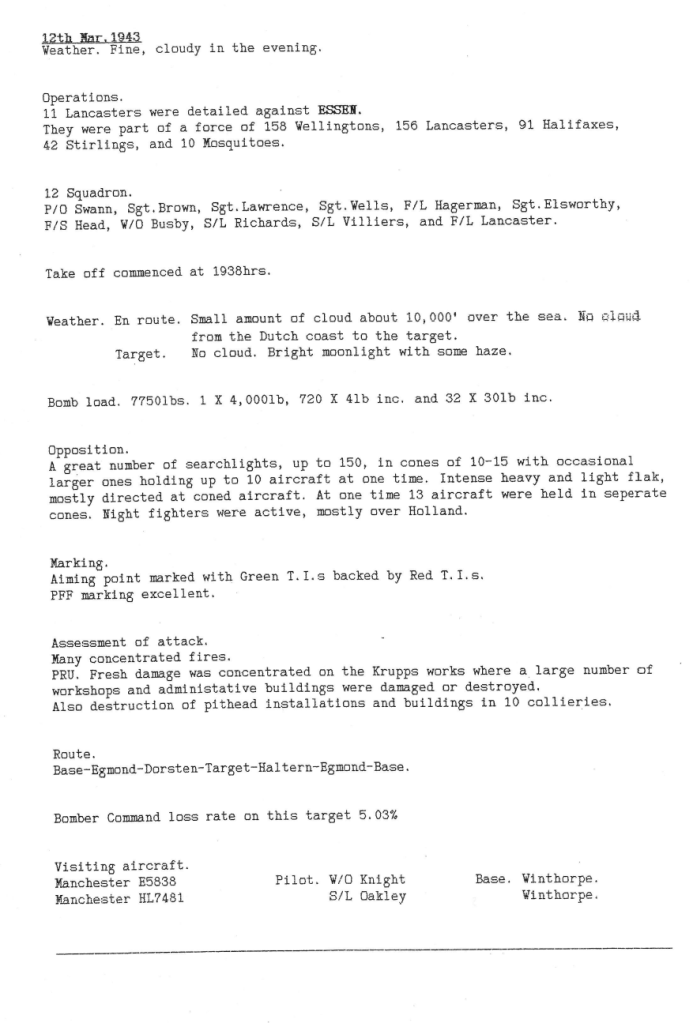
Although at the beginning of the Battle of the Ruhr, you will notice that this week, although 12 Sqn took part in 4 operations, only one was to the Ruhr – Essen on 12/13 March. The others were to targets much further into Germany; Nuremberg, Munich and Stuttgart. Fortunately, there were no casualties for 12 Sqn this week.

Extract from Station Diary

1-7 March 1943

Overview

The later part of this week marked the beginning of what Sir Arthur Harris called the Battle of the Ruhr (5/6 March to 24 July 1943), relying on concentrated bombing of a specific area until that area was destroyed. As we will see, not all the targets were in the Ruhr, although around two thirds were, mainly to prevent the Germans from concentrating all their ground and air defense systems in that one area. Other reasons for choosing the Ruhr was the shorter distance to travel as the nights in Spring and Summer were shorter and the fact that the Oboe blind marking system was still effective at that range.

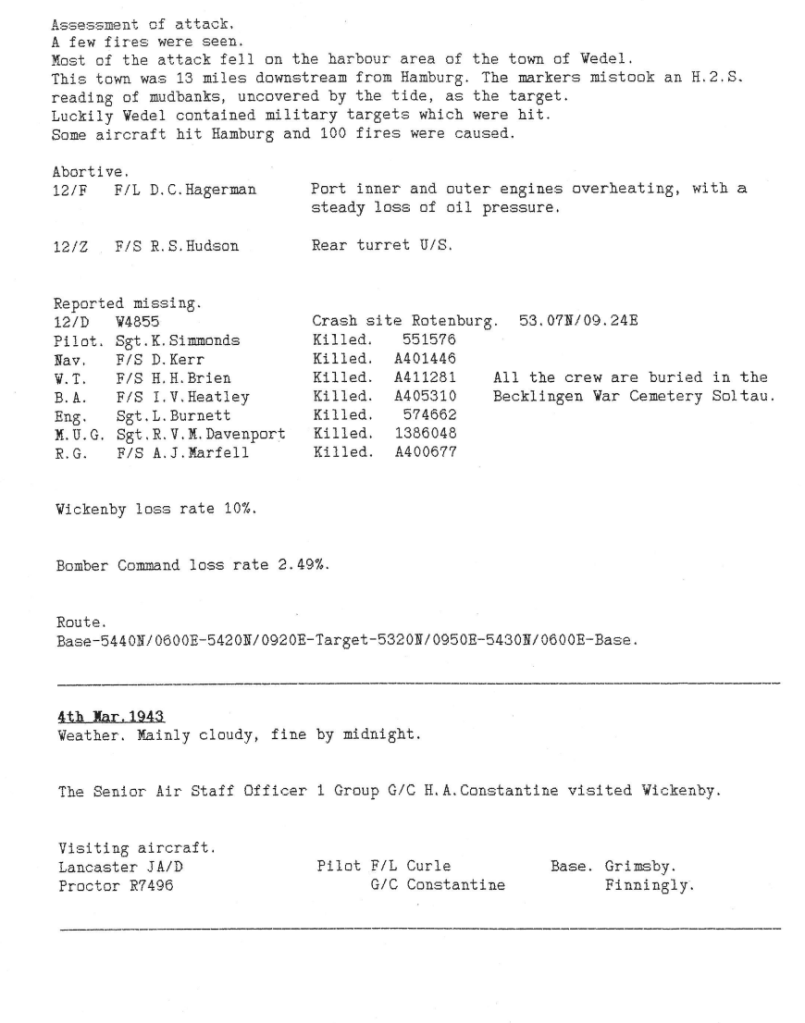
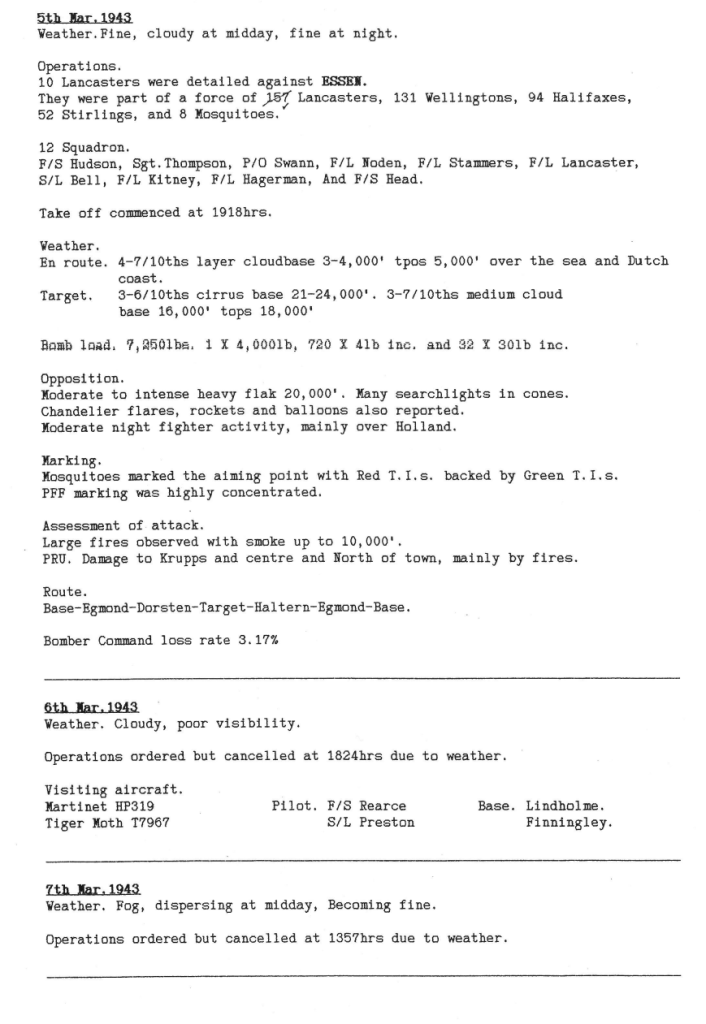
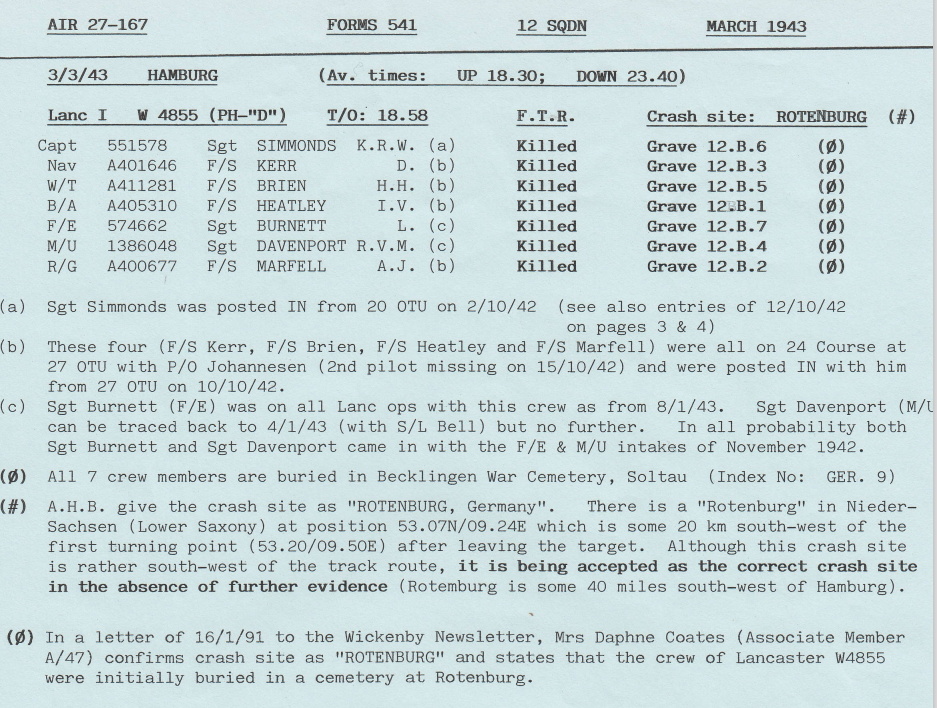
12 Sqn took part in 3 operations this week, to Berlin, Hamburg and Essen – one aircraft with all its crew were lost.

Extract from 12 Sqn Diary

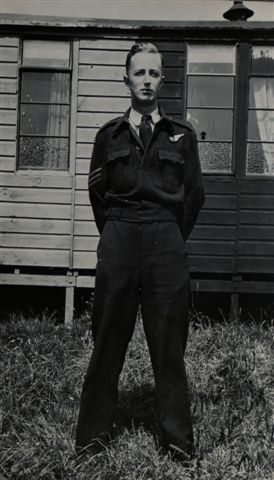
Flight Sergeant Donald Kerr, 26 the son of Mr & Mrs AG Kerr of Hampton, Victoria, Australia. He was the Navigator in the aircraft piloted by Sgt Simmonds, lost with all the crew during the attack on Hamburg on the night of 3/4 March 1943

Extract from Appendix to the Operational Record Book – 12 Sqn

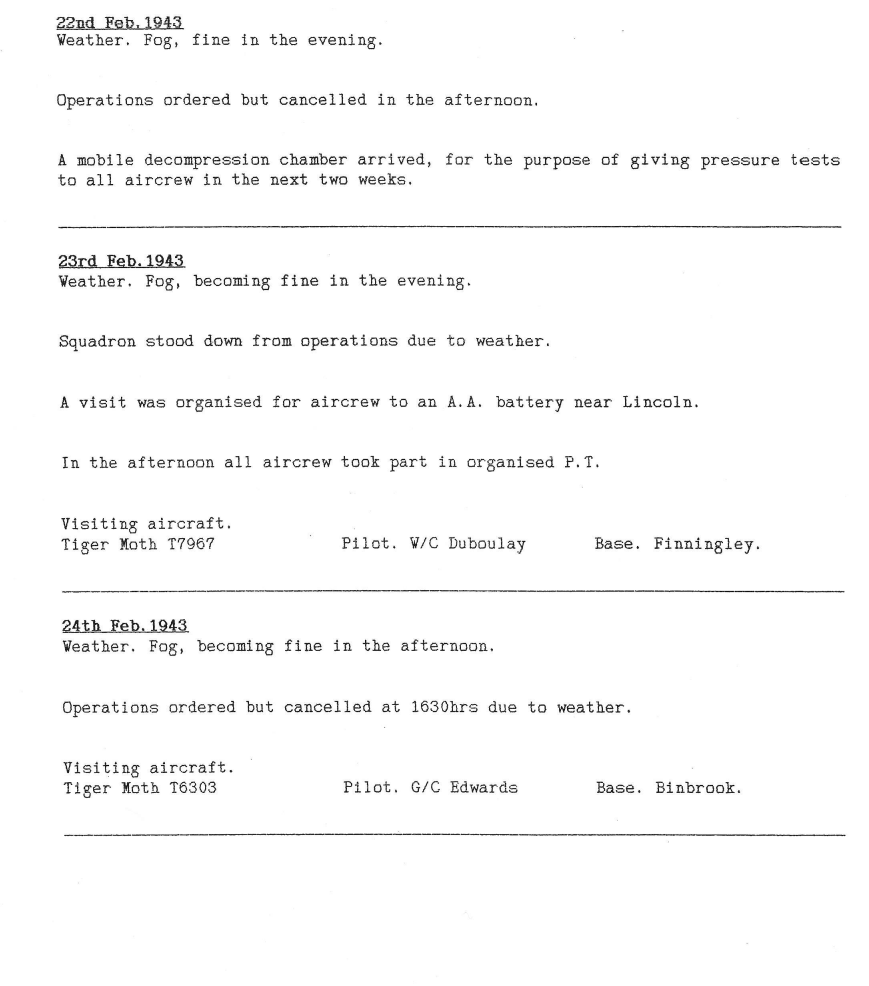
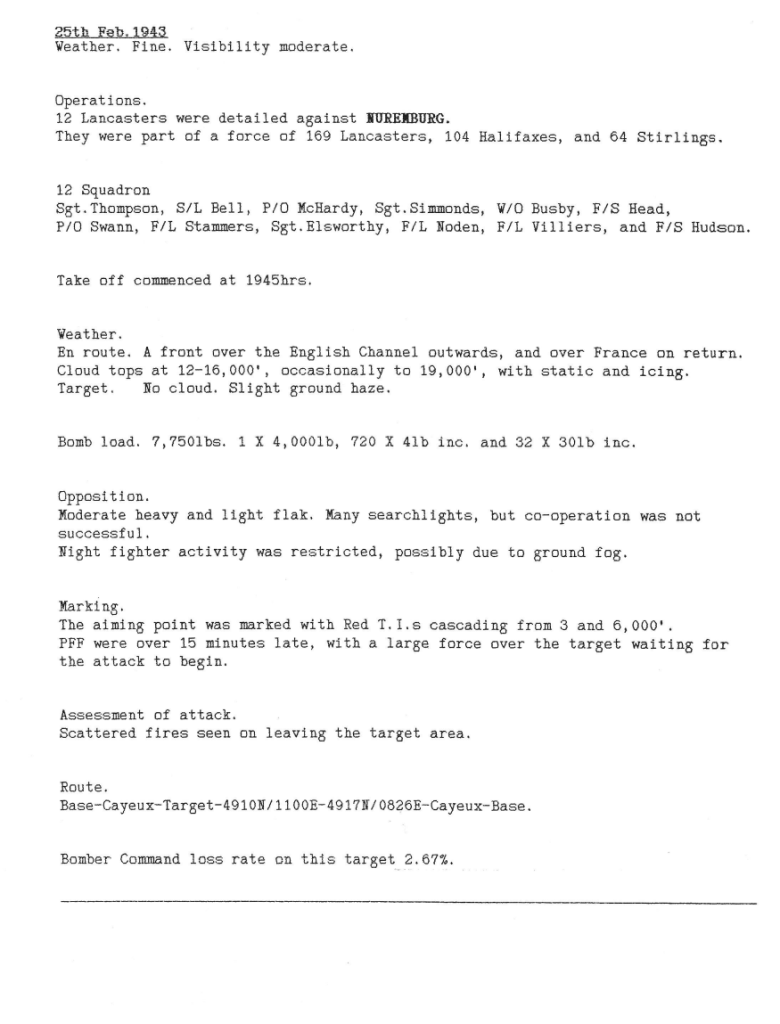
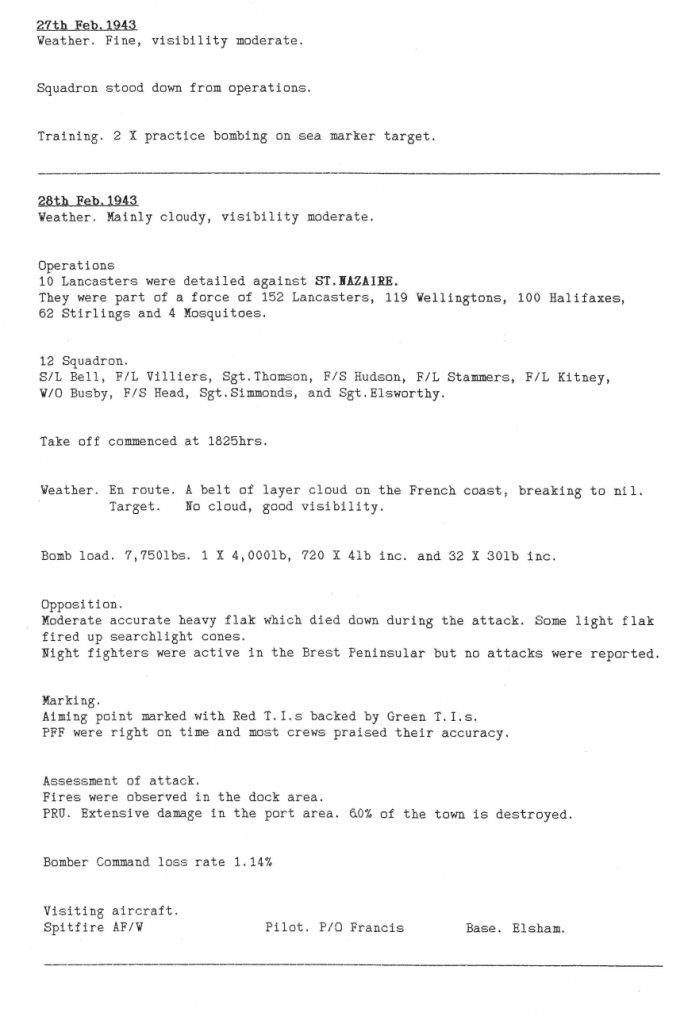
22-28 February 1943

Overview

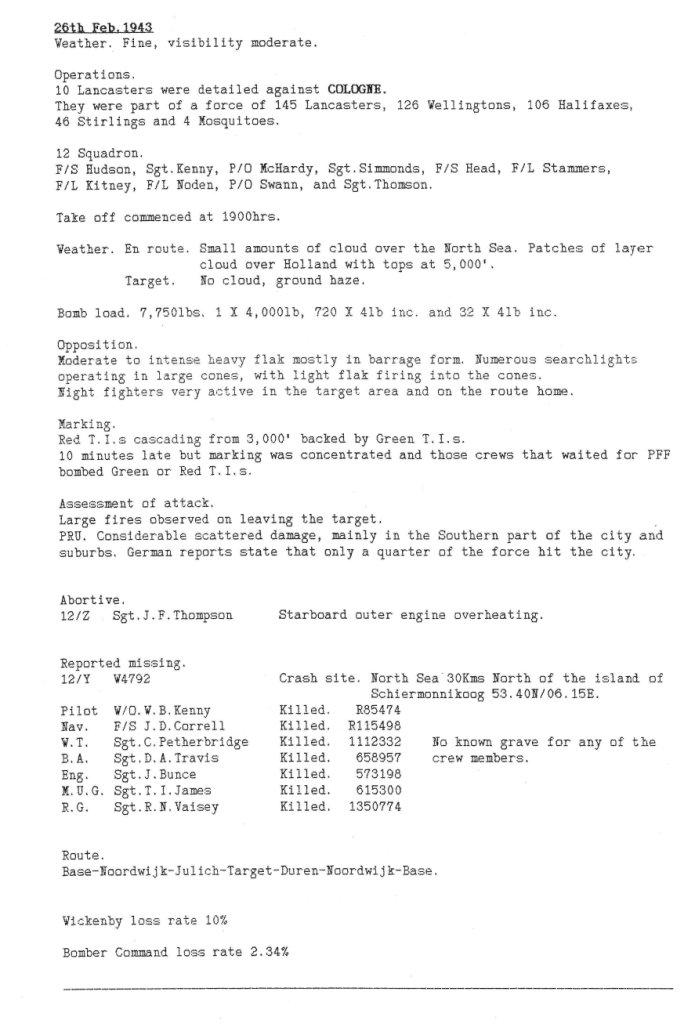
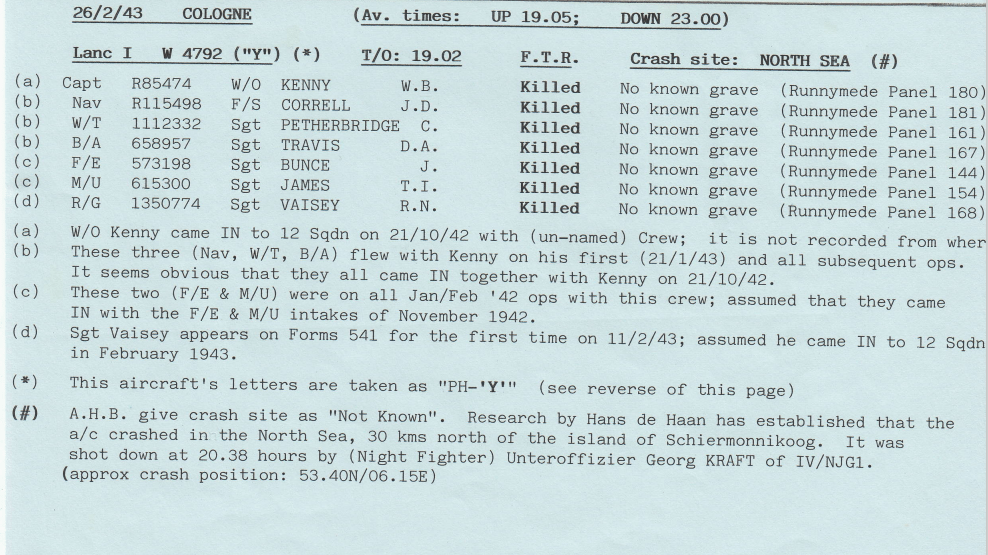
Fog in Lincolnshire was an issue this week with operations being cancelled on 3 days. 12 Sqn took part in 3 operations to Nuremburg, Cologne and St Nazaire. One aircraft with all its crew were lost during the Cologne raid. St Nazaire was second on the list of French U-boat bases, Lorient having been pretty much destroyed and this raid destroyed about 60% of the town and killed 29 people and injured 12.

Extract from 12 Sqn Diary

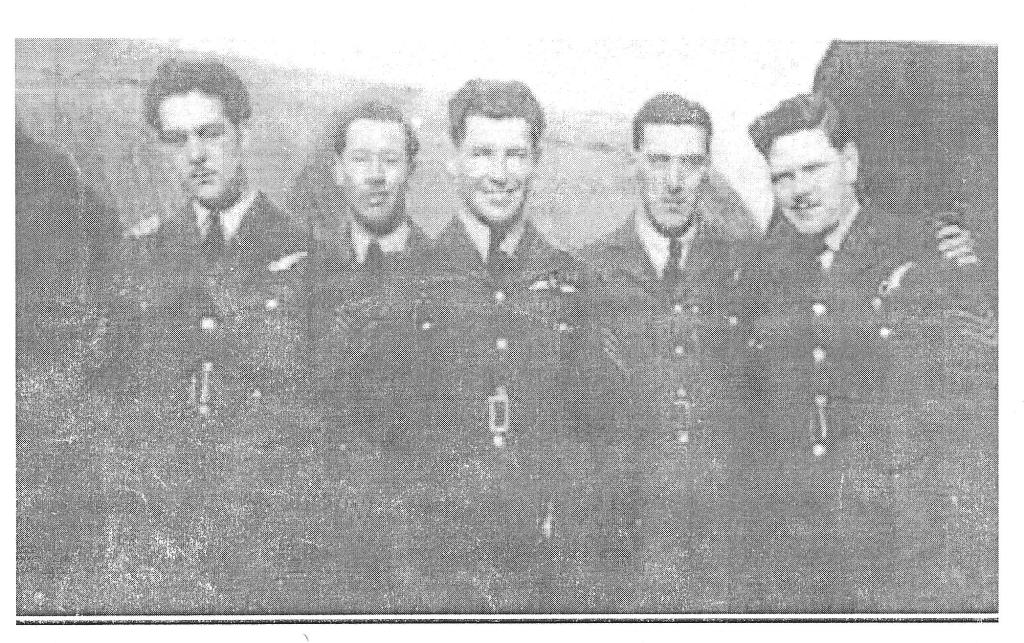
WO Kenny and some of his crew who were killed during the raid on Cologne on the night of 26/27 February 1943. Sgt Travis, the Bomb Aimer is far left, WO Kenny is in the middle. WO William Booker Kenny was 26 and the son of Albert & Phyllis Grace Kenny of Wolseley, Saskatchewan, Canada. Sgt Donald Armitage Travis was 20 and the son of Joseph Armitage Travis & Mary Gertrude Travis of Aintree, Liverpool

Extract from Appendix to 12 Sqn Operational Record Book
15-21 February 1943

Overview

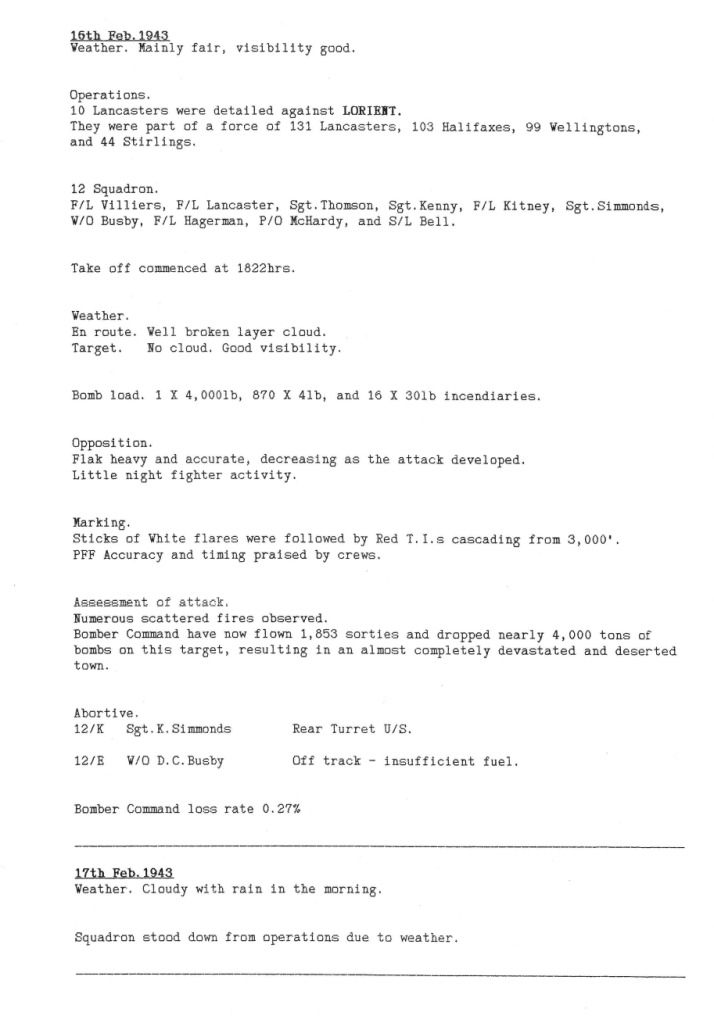
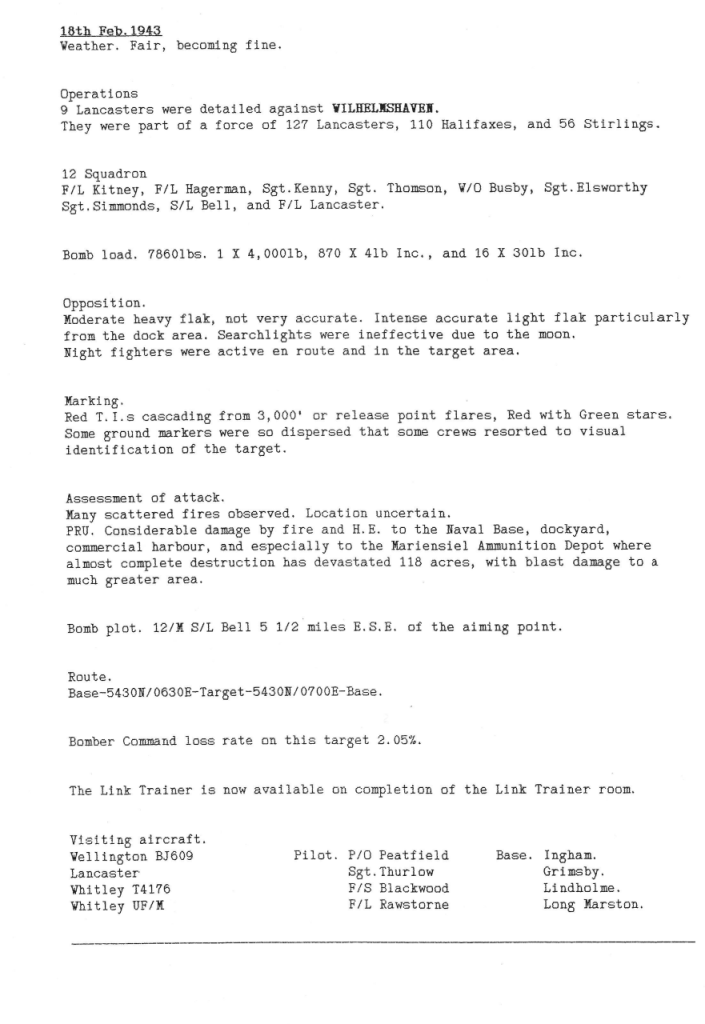
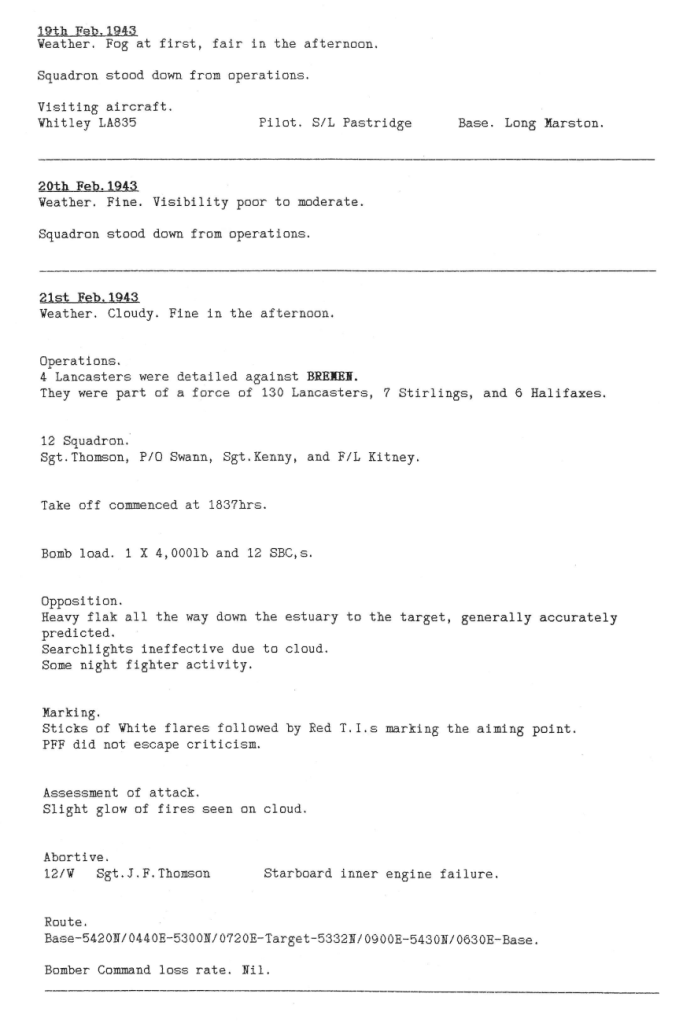
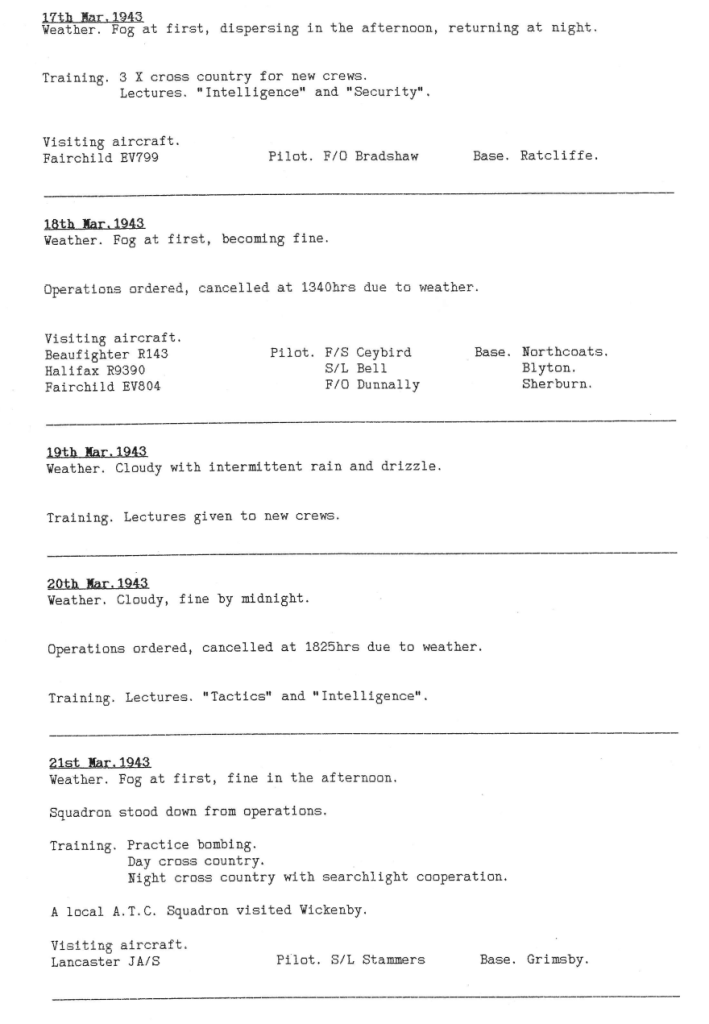
Another fairly quiet week for 12 Sqn; they took part in 3 raids to Lorient, Wilhelmshaven and Bremen and none of the squadron aircraft were lost. The raid on Lorient was the eighth following direct instructions from the Air Ministry and nearly 4000 tons of bombs had been dropped and 24 aircraft lost. The town was said to be completely ruined and deserted.
It may be useful to give a brief description of the type of marking used by the Pathfinder force to help the main force squadrons to hit their designated target. These are mentioned frequently in the Squadron Diary entries.

Types of marking

Three types of target marking were developed by the Pathfinders. These were known by the codenames Parramatta, Wanganui and Newhaven – the names coming from locations in Australia, New Zealand and the UK which had links with Pathfinder staff. If the Oboe system was used to determine the release point then the word “Musical” was used as a prefix, e.g. “Musical Parramatta”. Parramatta used navigation aids such as H2S radar or Oboe radio signals to drop the markers. Newhaven used illumination flares dropped above the target area to light it up sufficiently for a visual marking by the Pathfinder aircraft. Wanganui was used when the target was obscured by cloud, industrial haze, or a smoke screen. Oboe or H2S was used to release the markers over the unseen target. The target indicators used were on parachutes to give an aiming point that could be seen by the main force. This was also known as “sky marking”.

In all cases, further Target Indicators (TI) would be dropped in the course of the raid to reinforce the marking and to compensate for earlier TIs either burning out or being extinguished by the bombing.

Extract from 12 Sqn Diary