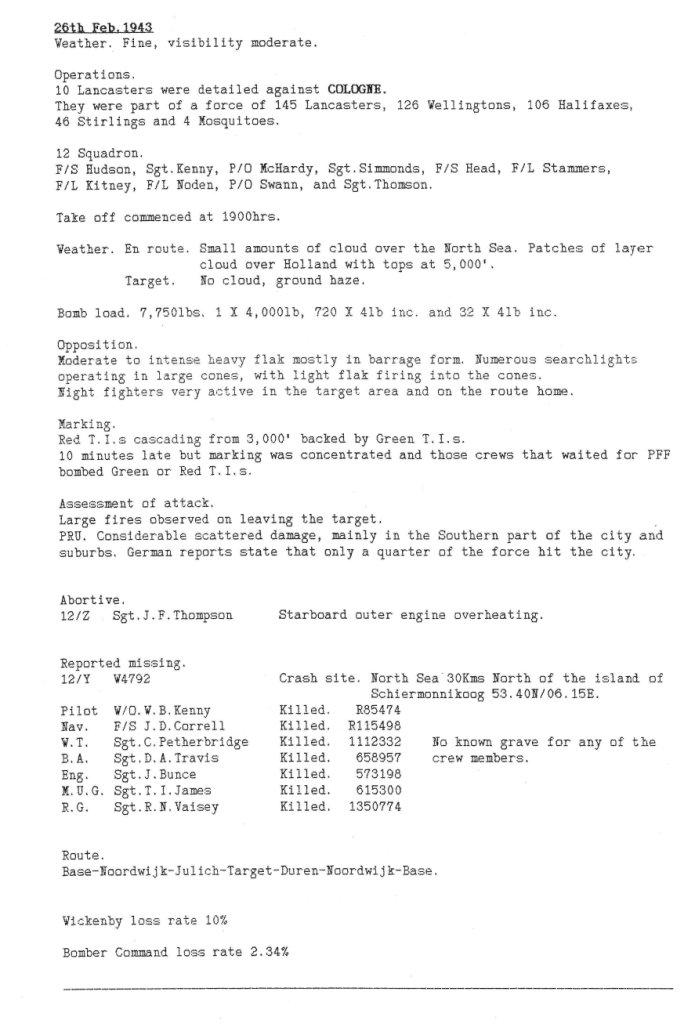
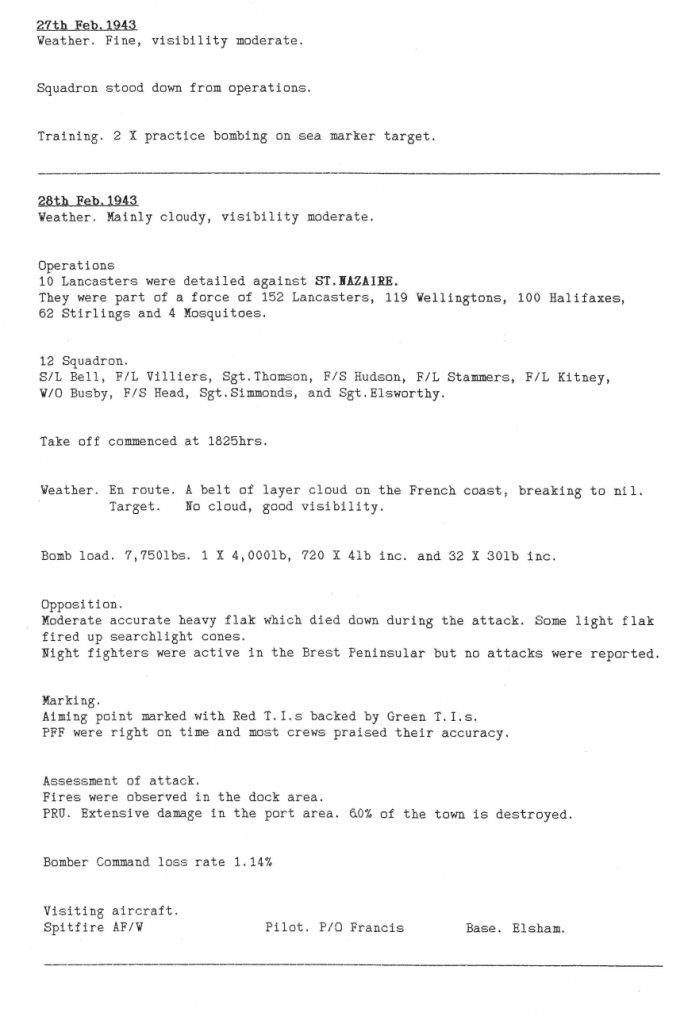
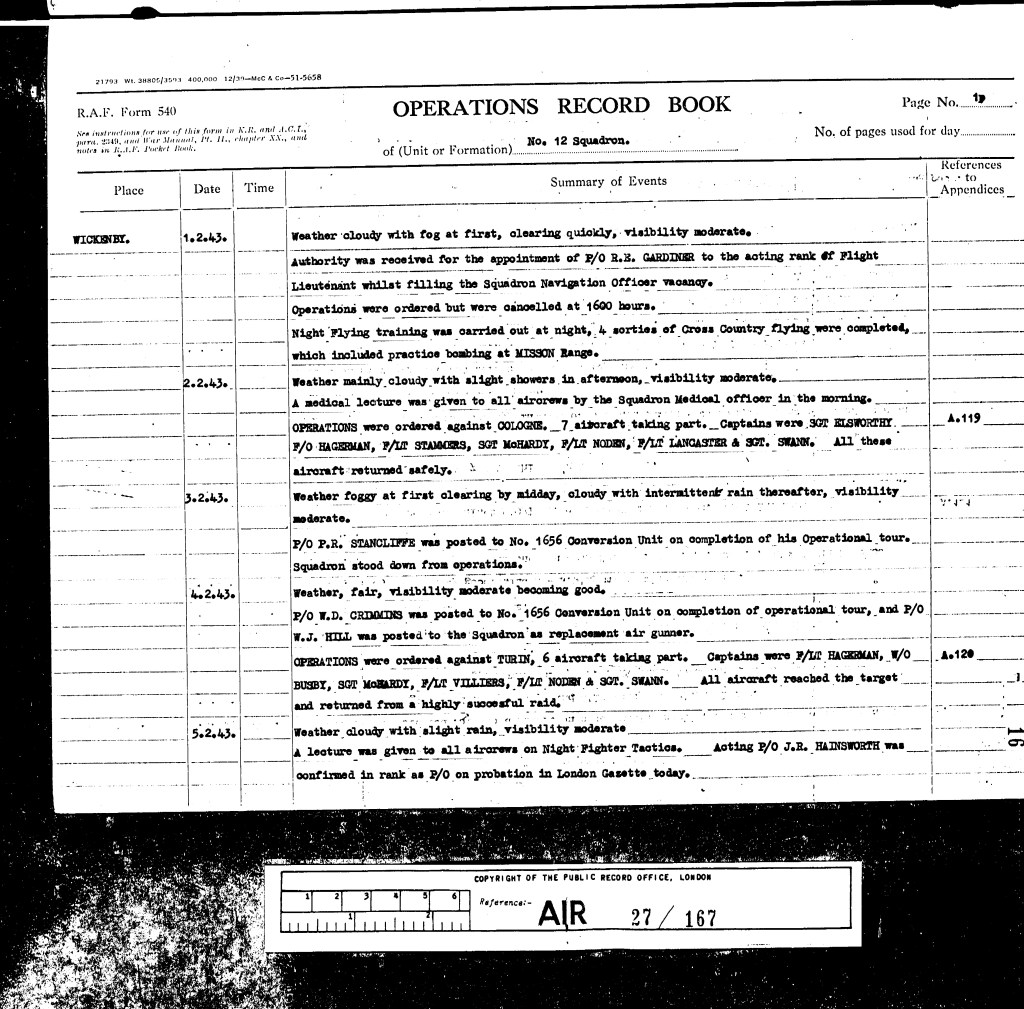
Fog in Lincolnshire was an issue this week with operations being cancelled on 3 days. 12 Sqn took part in 3 operations to Nuremburg, Cologne and St Nazaire. One aircraft with all its crew were lost during the Cologne raid. St Nazaire was second on the list of French U-boat bases, Lorient having been pretty much destroyed and this raid destroyed about 60% of the town and killed 29 people and injured 12.
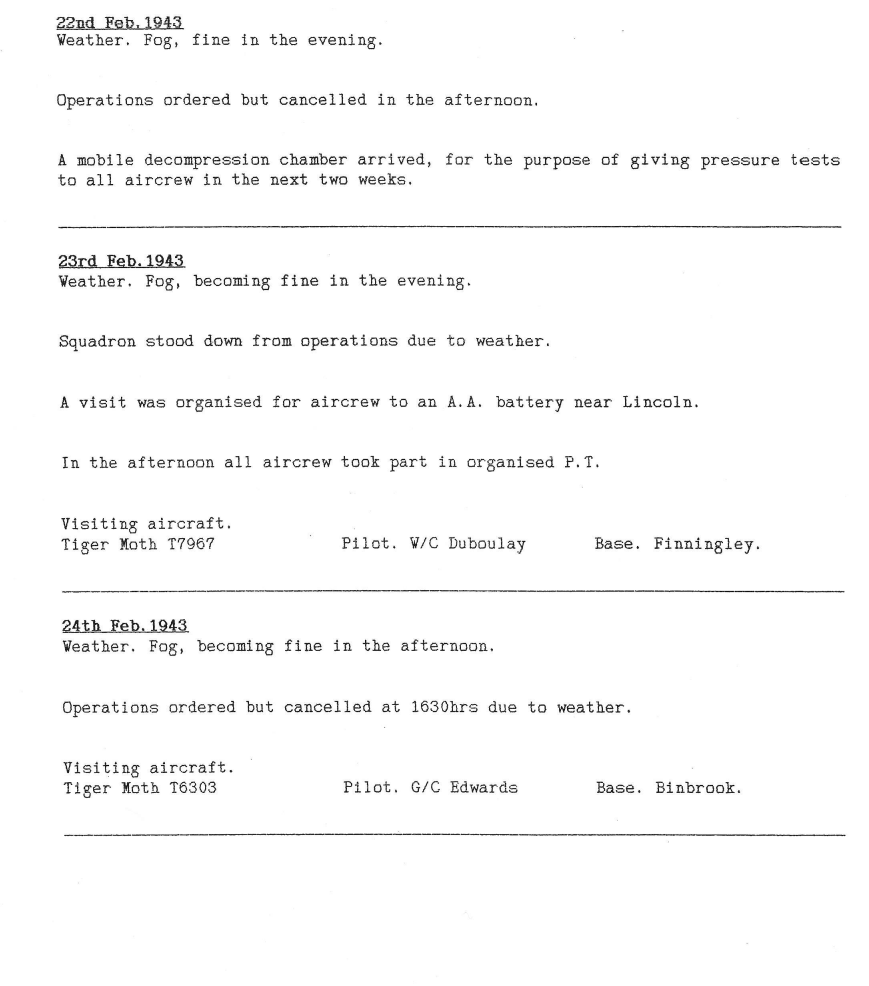
Extract from 12 Sqn Diary
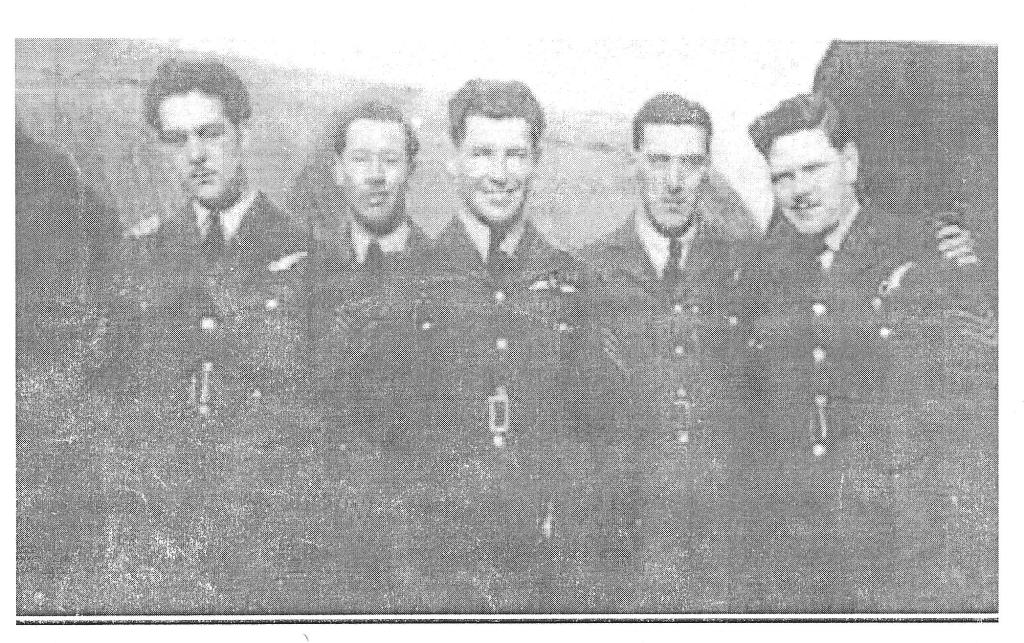
WO Kenny and some of his crew who were killed during the raid on Cologne on the night of 26/27 February 1943. Sgt Travis, the Bomb Aimer is far left, WO Kenny is in the middle. WO William Booker Kenny was 26 and the son of Albert & Phyllis Grace Kenny of Wolseley, Saskatchewan, Canada. Sgt Donald Armitage Travis was 20 and the son of Joseph Armitage Travis & Mary Gertrude Travis of Aintree, Liverpool
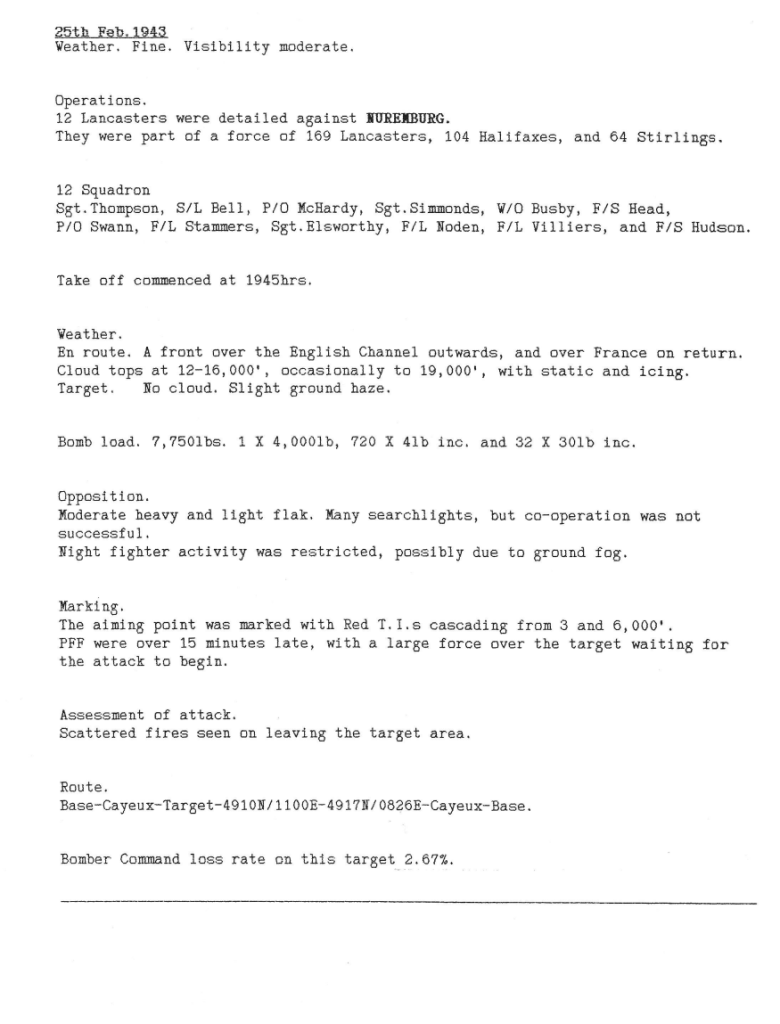
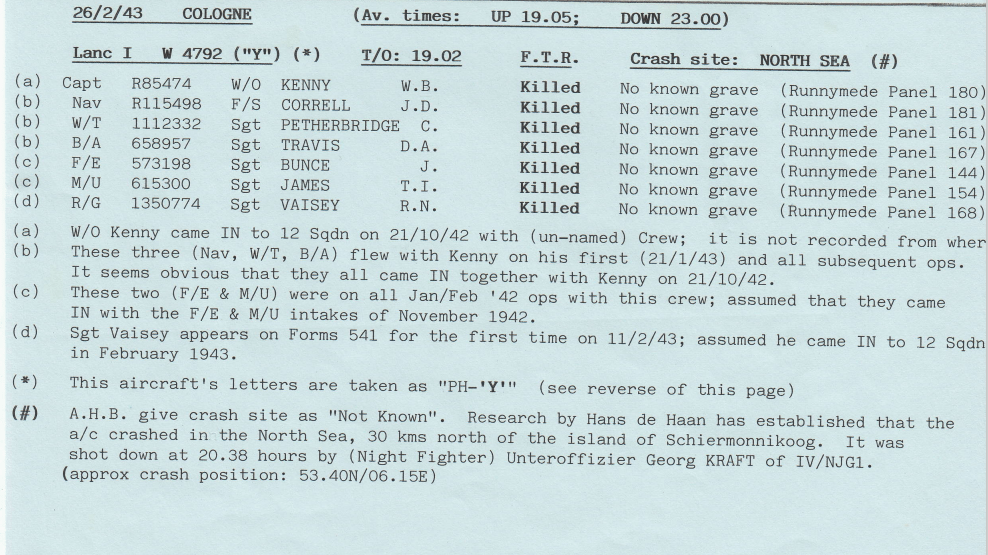
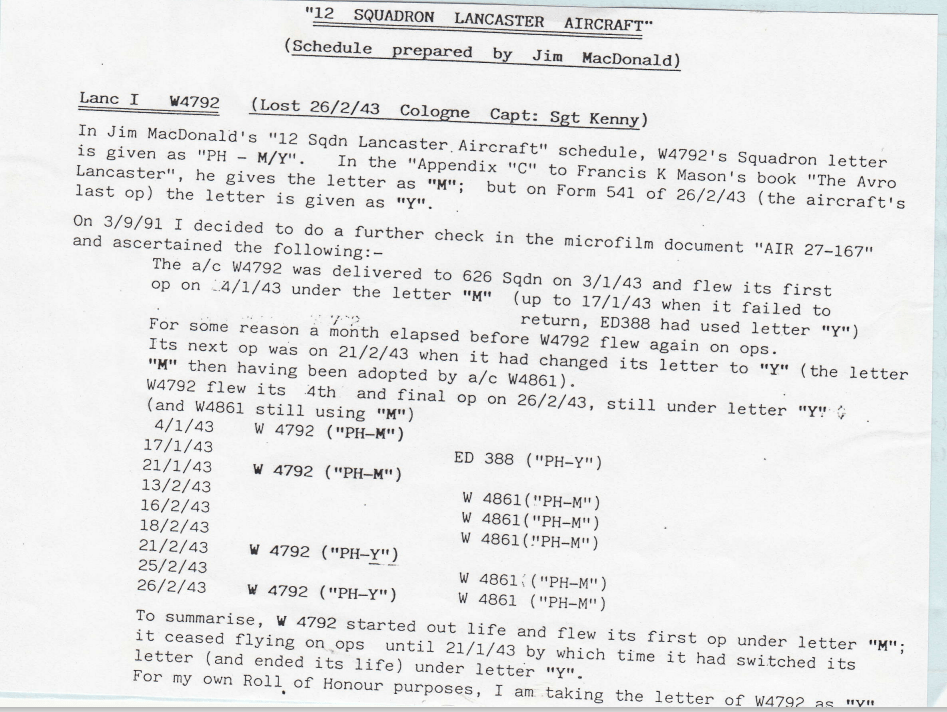
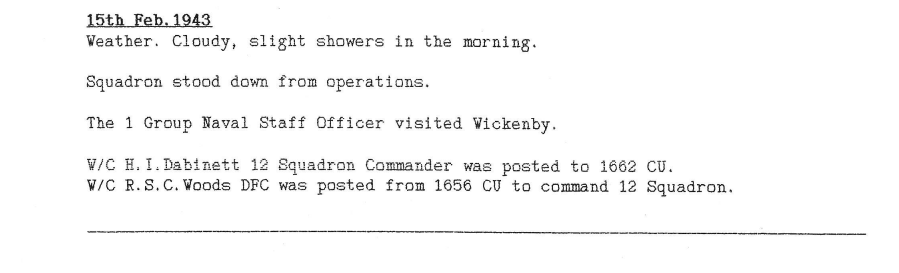
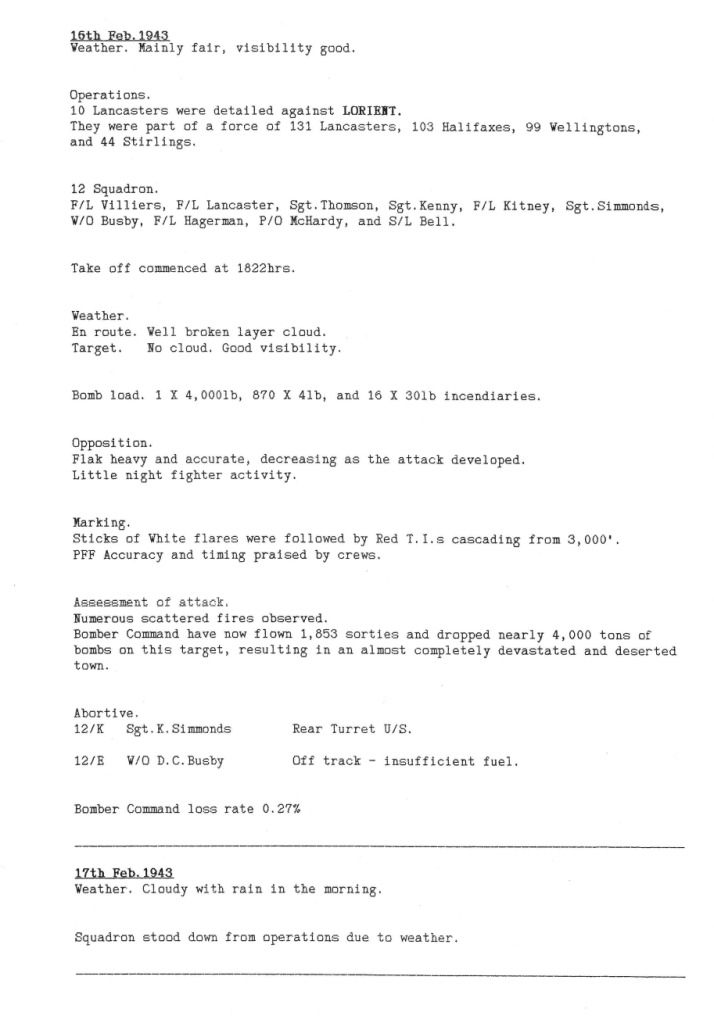
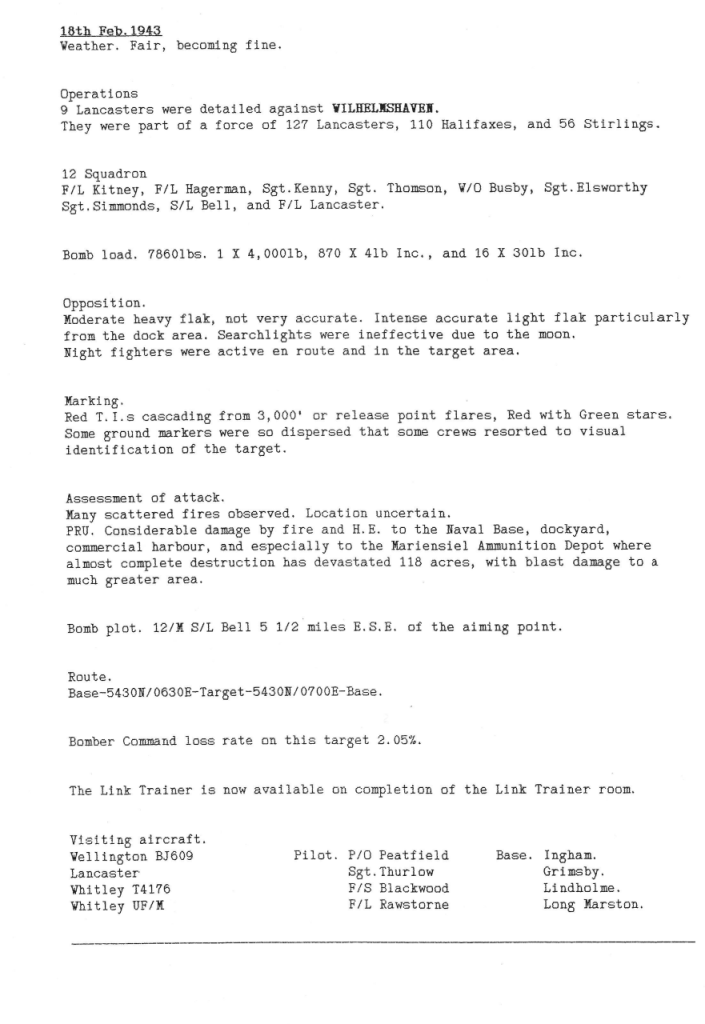
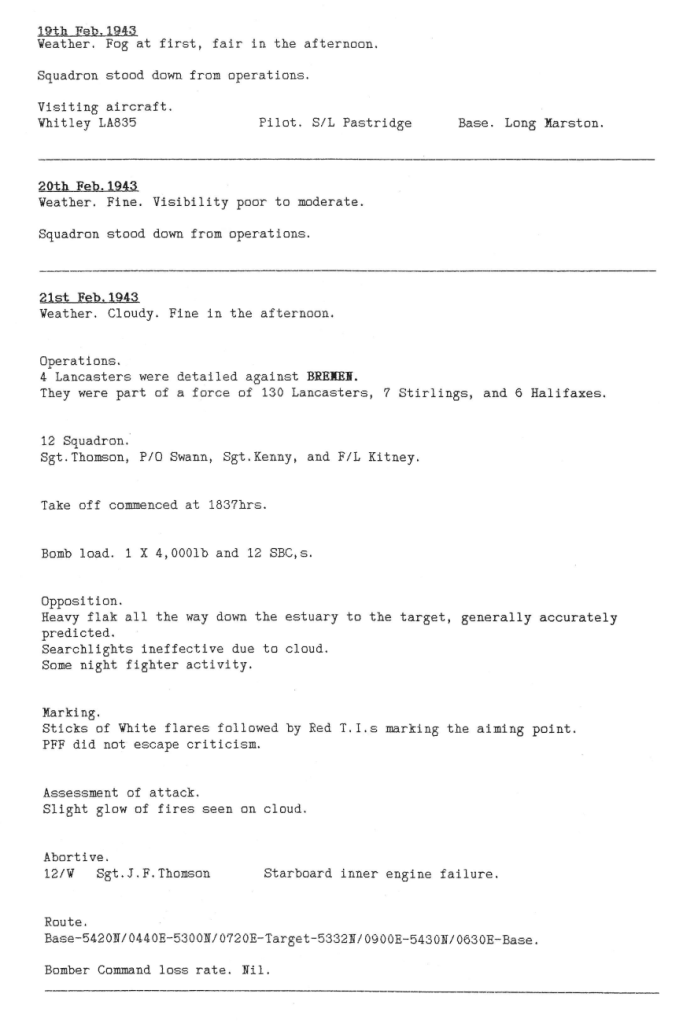
Extract from Appendix to 12 Sqn Operational Record Book
Another fairly quiet week for 12 Sqn; they took part in 3 raids to Lorient, Wilhelmshaven and Bremen and none of the squadron aircraft were lost. The raid on Lorient was the eighth following direct instructions from the Air Ministry and nearly 4000 tons of bombs had been dropped and 24 aircraft lost. The town was said to be completely ruined and deserted.
It may be useful to give a brief description of the type of marking used by the Pathfinder force to help the main force squadrons to hit their designated target. These are mentioned frequently in the Squadron Diary entries.
Types of marking
Three types of target marking were developed by the Pathfinders. These were known by the codenames Parramatta, Wanganui and Newhaven – the names coming from locations in Australia, New Zealand and the UK which had links with Pathfinder staff. If the Oboe system was used to determine the release point then the word “Musical” was used as a prefix, e.g. “Musical Parramatta”. Parramatta used navigation aids such as H2S radar or Oboe radio signals to drop the markers. Newhaven used illumination flares dropped above the target area to light it up sufficiently for a visual marking by the Pathfinder aircraft. Wanganui was used when the target was obscured by cloud, industrial haze, or a smoke screen. Oboe or H2S was used to release the markers over the unseen target. The target indicators used were on parachutes to give an aiming point that could be seen by the main force. This was also known as “sky marking”.
In all cases, further Target Indicators (TI) would be dropped in the course of the raid to reinforce the marking and to compensate for earlier TIs either burning out or being extinguished by the bombing.
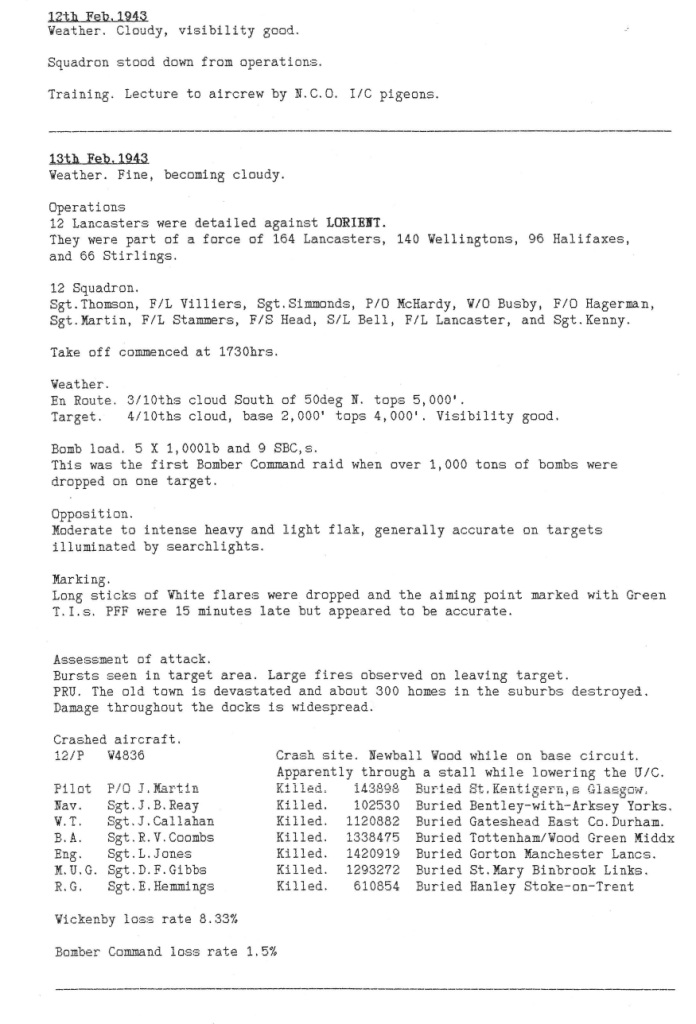
12 Sqn took part in 3 operations during this week, to Wilhelmshaven, Milan and Lorient. Two of these missions were interesting as the Wilhelmshaven raid was the first successfully marked by the Pathfinders using sky-marking (usually the most unsuccessful method) through complete cloud cover using H2S. Lorient was the first where 1000 tons of bombs were dropped on a target by Bomber Command.
Also this week, carrier pigeons were carried for the first time by 12 Sqn, 2 per aircraft. They were kept in a loft at RAF Binbrook and were to be used if the aircraft had a forced landing outside the UK.
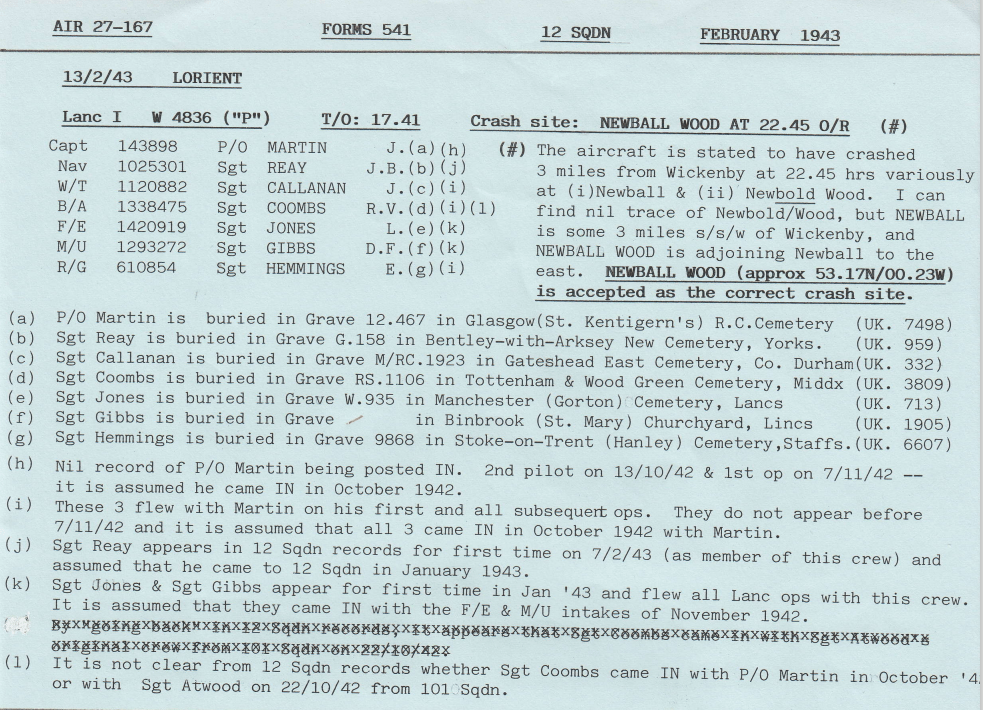
One aircraft was lost this week, with all the crew being killed.
Extract from 12 Sqn Diary
Extract from 12 Sqn Appendix to Operational Record Book
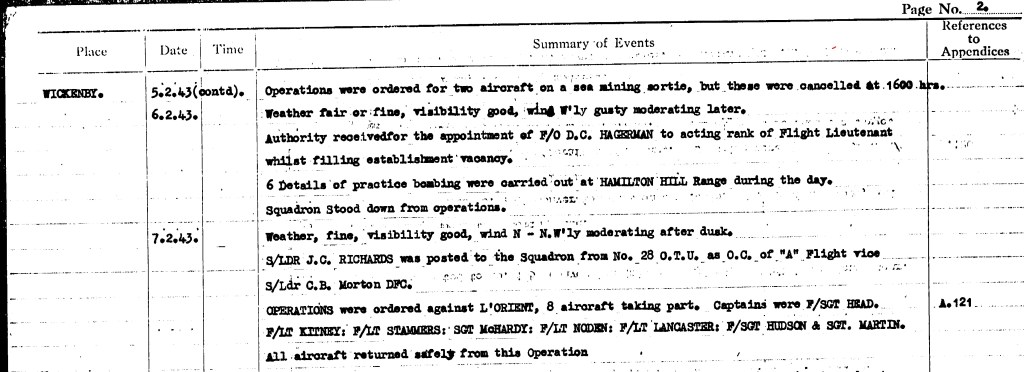
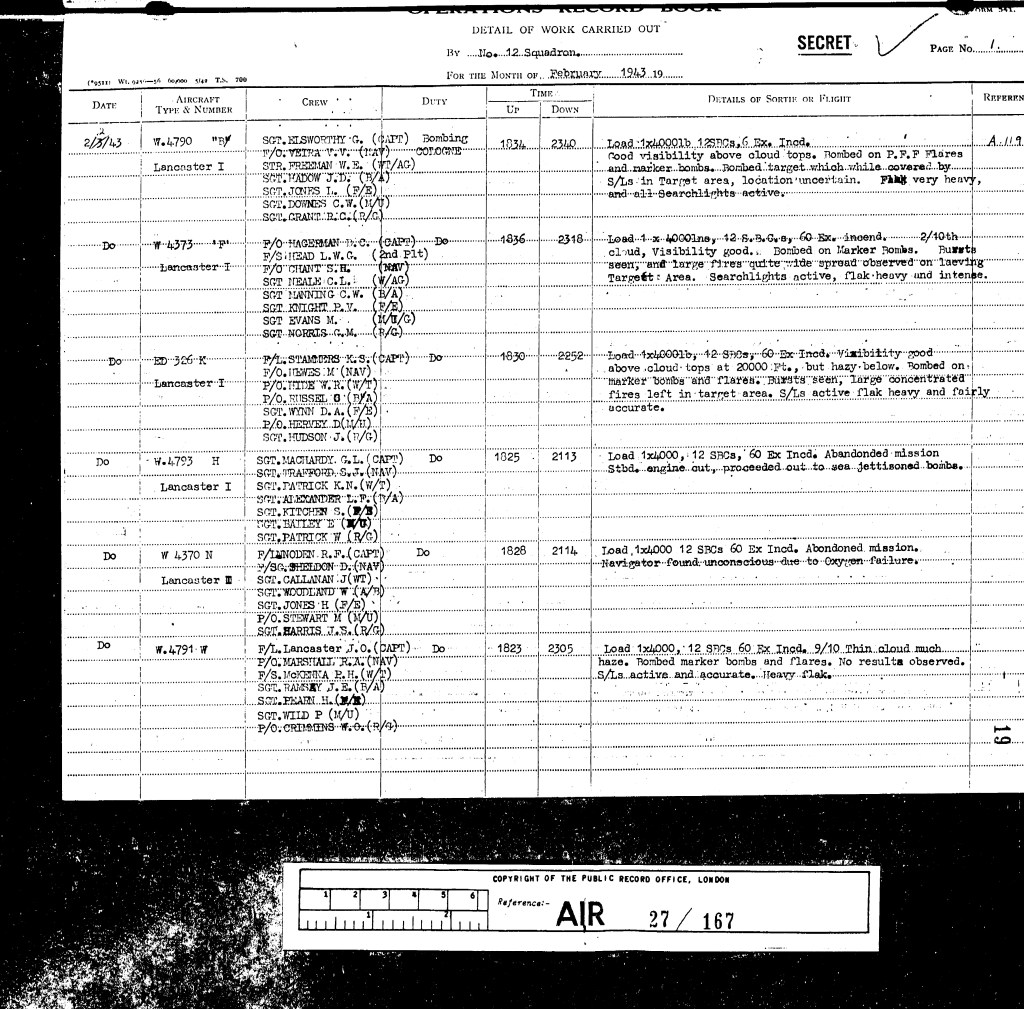
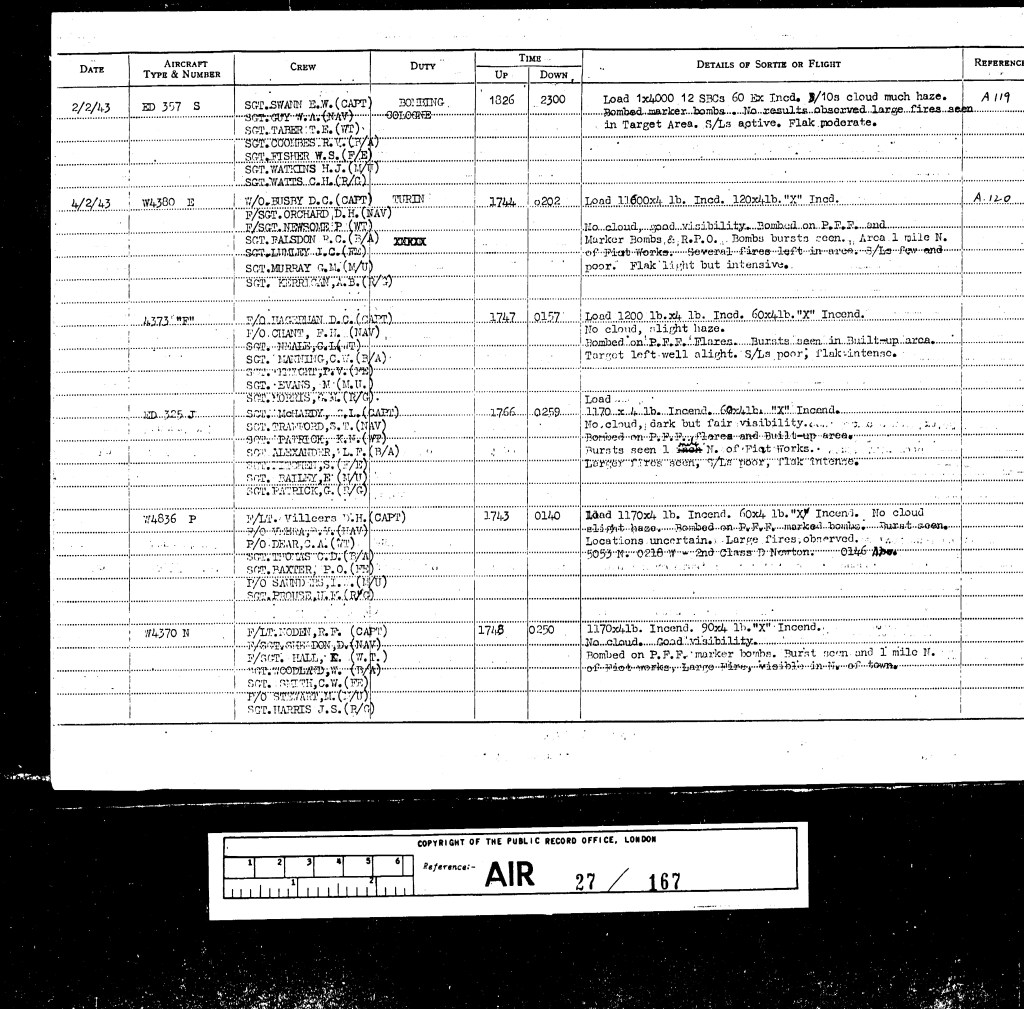
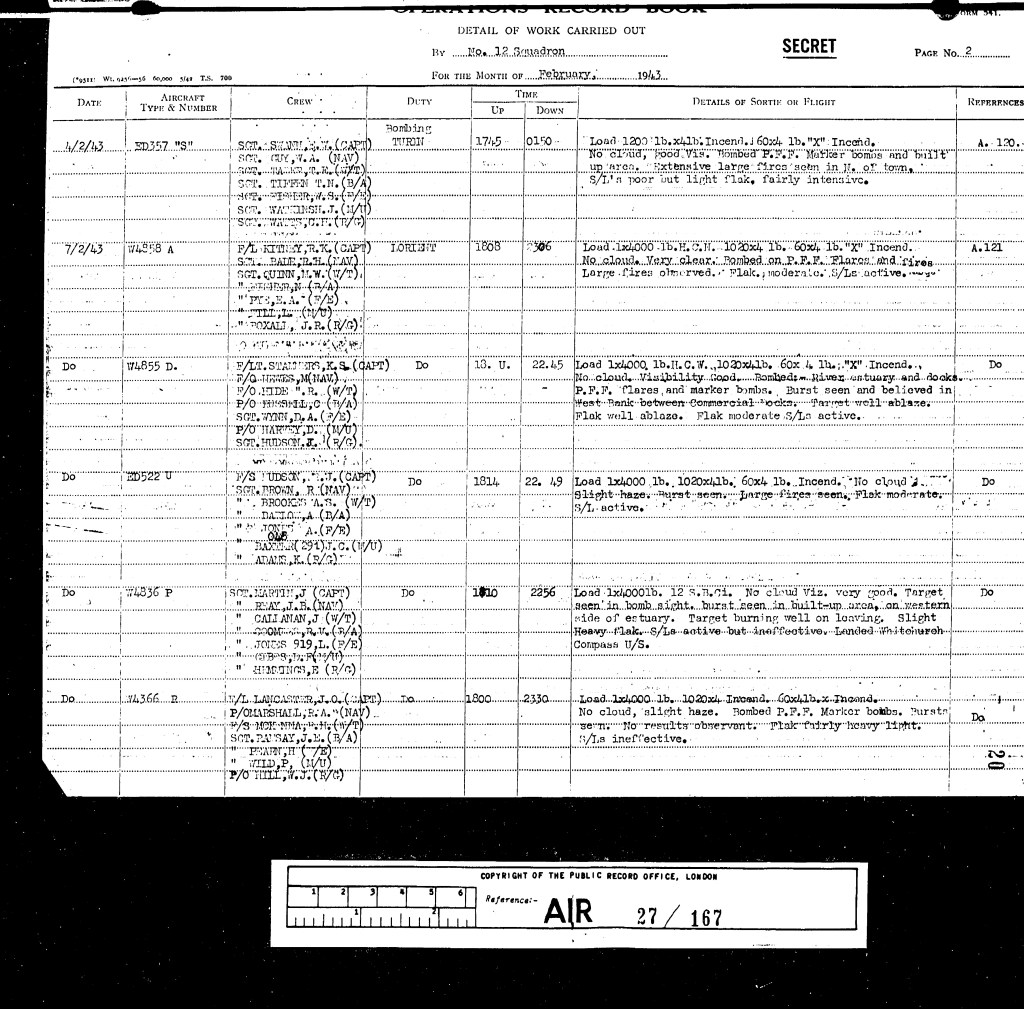
Another week without any casualties for 12 Sqn although they took part in attacks on Cologne (161 Bomber Command aircraft); Turin (188 aircraft) and L’Orient (128 aircraft).
During the raid on Cologne, a Pathfinder Stirling of 7 Squadron, was shot down by a night fighter and crashed in Holland. Unfortunately, it contained an H2S set (as described in an earlier post) in only the second operation using that technology. The Germans managed to repair and reassemble the damaged equipment and this led, eventually, to the development of a device codenamed “Naxos” which was used to home onto bombers that were using H2S.
Extract from 12 Sqn Operational Record Book
Flight Lieutenant D.H. Villiers (front left) and his crew, who took part in the raid on Turin on 4th February 1943.The aptly named Flt Lt J.O. Lancaster, who took part in the raids on Cologne and L’Orient this week. He, and his crew, eventually completed a full 30 operations at Wickenby.
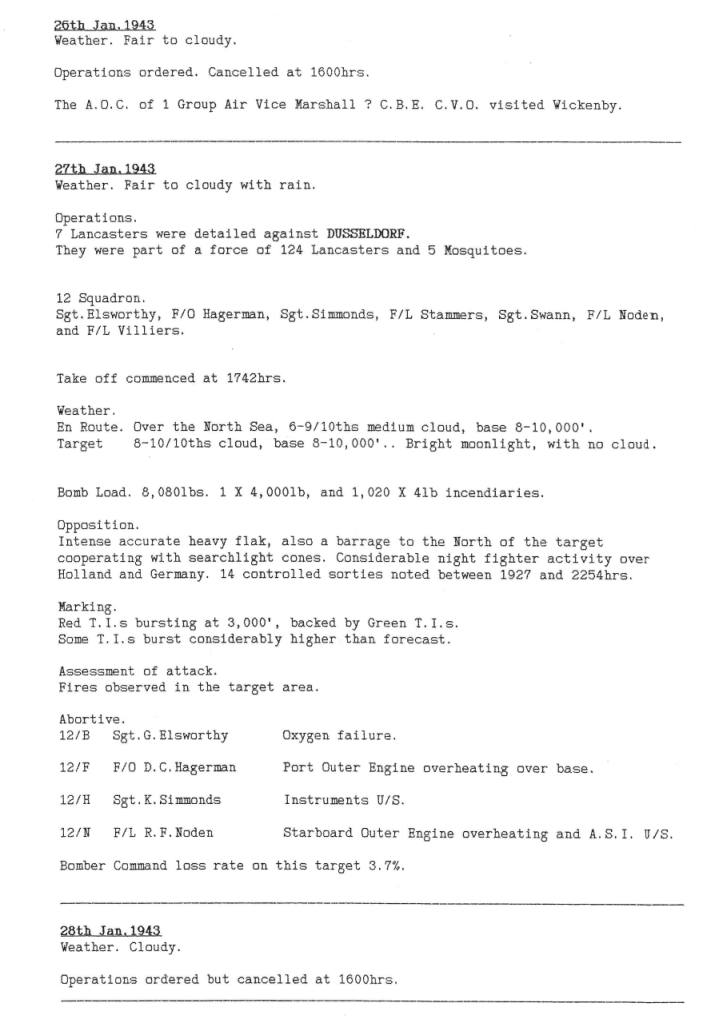
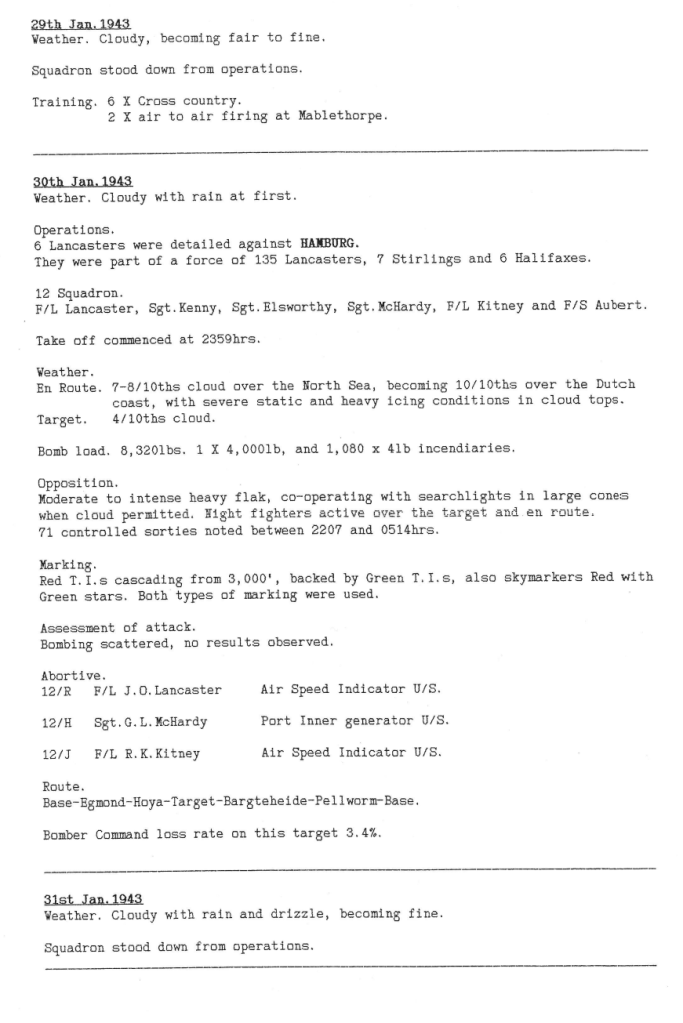
12 Sqn suffered no casualties during this week but did dispatch 13 aircraft on missions to Dusseldorf and Hamburg, although only 6 attacked the targets. Bad weather was the order of the day for most of the week.
This week also saw the first use of “ground marking” using Oboe by Pathfinder Mosquitoes in the attack on Dusseldorf and the first H2S attack of the war, with Pathfinder Stirlings and Halifaxes using the device to mark targets in Hamburg.
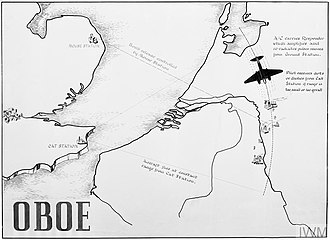
Oboe was a British bomb aiming system developed to allow their aircraft to bomb targets accurately in any type of weather, day or night. Oboe coupled radar tracking with radio transponder technology. The guidance system used two well separated radar stations to track the aircraft. Each Oboe tracking station used radio ranging to define a circle, the radius of which was the distance from the station to the target, the third point in the triangulation. The two circles intersected at the target. Radar pulses from each station were picked up by a transponder mounted in the aircraft. The aircraft transponder transmitted the signals back to the stations, after a slight delay. By assessing the time it took for the signal to return the distance between the station and the aircraft could be determined. One tracking station, the Cat station, was used to adjust the aircraft’s flight path. The other station, the Mouse, was used to key the bomb release point. Oboe, in essence, was a ground-controlled, blind bombing system. (Wikipedia)
An illustration of Oboe. Two radar stations track the flight of the aircraft. The southern station is the Cat which generates pulses whose arc is defined by the distance from the station to the target. The aircraft will fly along the arc from a start point ten minutes flight from the target. As it approaches the intersect with the arc from the Mouse station the aircraft is signaled to prepare for bomb release. When the aircraft reaches the point where the two arcs intersect the Mouse station transmits the signal to release bombs. (Wikipedia)
H2S was the first airborne, ground scanning radar system. It was developed to identify targets on the ground for night and all-weather bombing. This allowed attacks outside the range of the various radio navigation aids like Gee or Oboe, which were limited to about 350 kilometres (220 mi). It was also widely used as a general navigation system, allowing landmarks to be identified at long range. (Wikipedia)
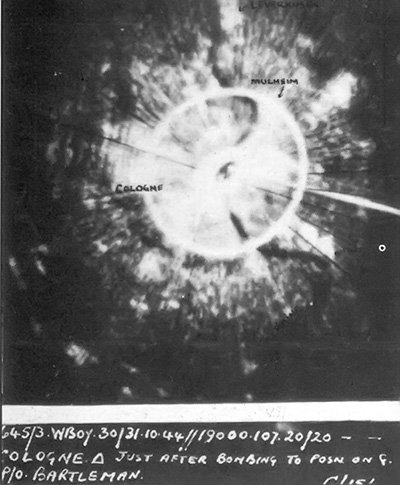
A photograph of the H2S display taken during an attack on Cologne – the annotations were added later for post attack analysis. The river Rhine is visible snaking from top to lower right. (Wikipedia)
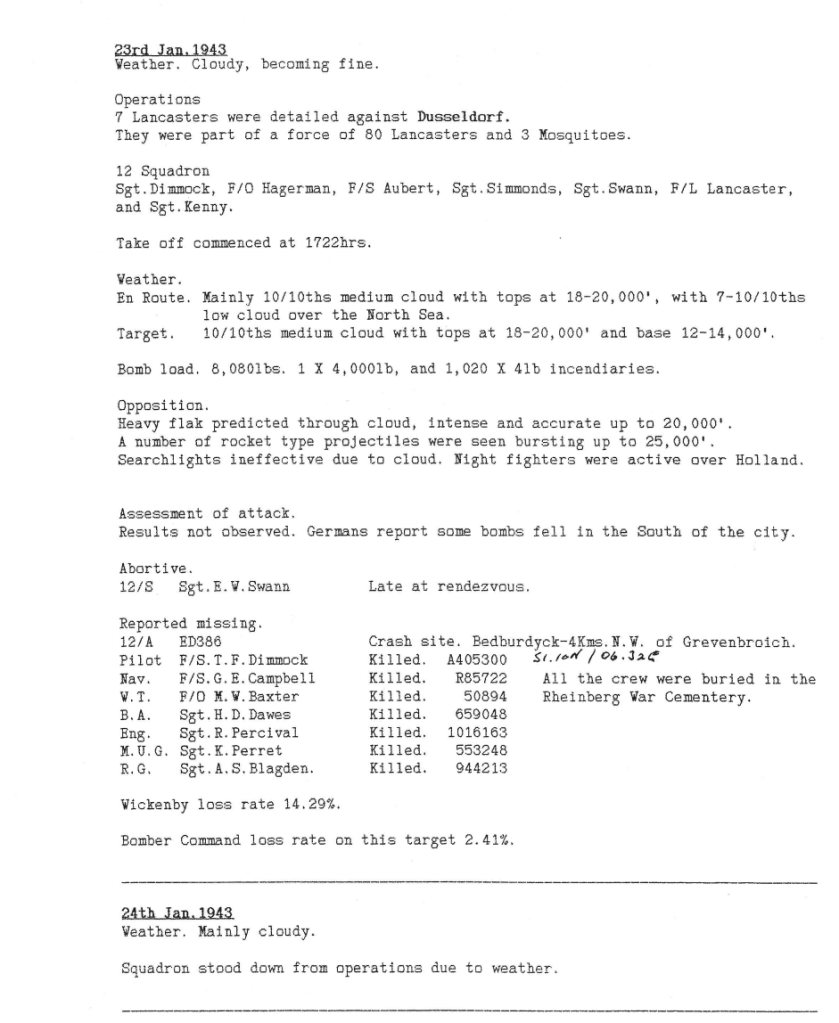
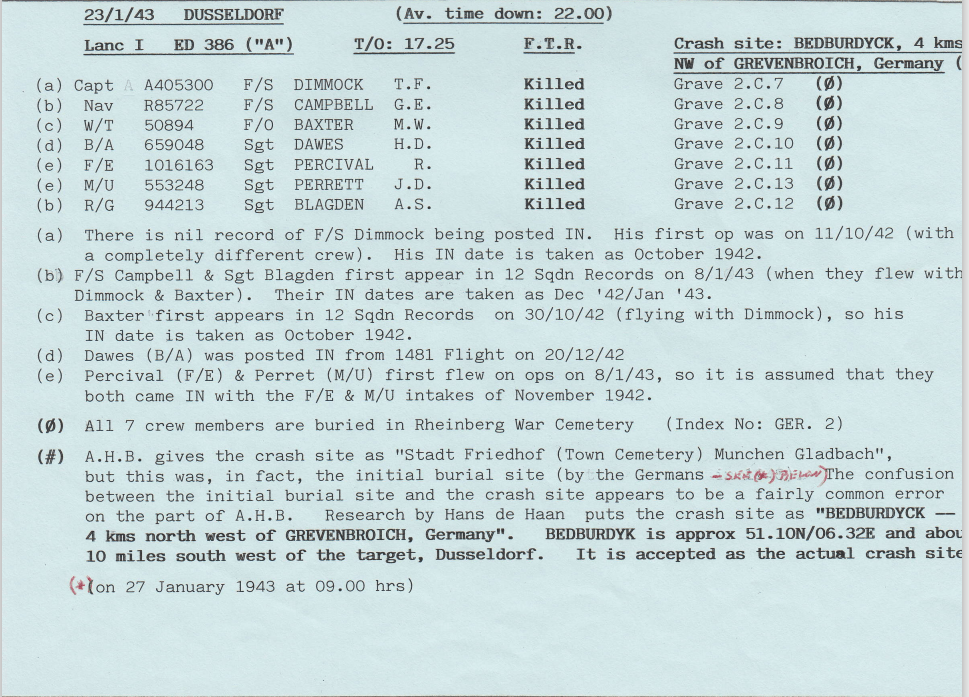
This was a quieter week for 12 Sqn due to inclement weather with only 2 operations being carried out and 1 aircraft and crew lost attacking Dusseldorf. This was one of only 2 Lancasters lost on that mission, the other being from 460 Sqn.
Weather was always a major problem for Bomber Command and 10/10ths cloud i.e. complete cloud cover, made finding and marking a target extremely difficult, if not impossible. Equally, the weather over the target might be clear enough for an attack but if there was to be bad weather, for the return leg, over the bomber airfields in the East of England, especially fog, then operations would normally be cancelled. Another factor affecting missions was the state of the moon. As Bomber Command main force (of which RAF Wickenby was a part) only attacked at night, a full or three quarter moon normally meant no flying as it presented too much visibility to the enemy night fighters. Of course, the Germans knew this too, so could estimate on which nights they might be attacked by the RAF, based on the moon and the weather, but they just didn’t know where and what route would be taken.
Extract from 12 Sqn Diary
Extract from Appendix to 12 Sqn Operational Record Book
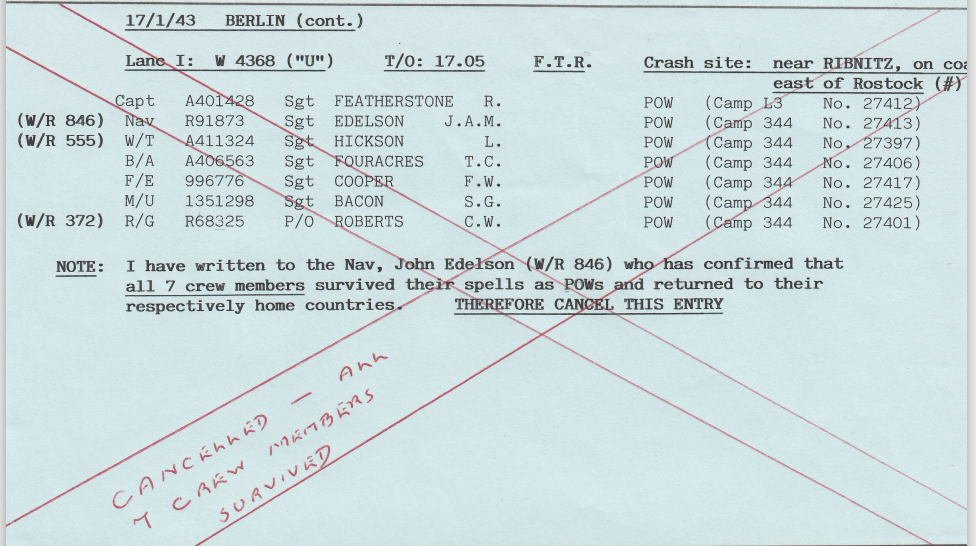
Comments at the bottom of this page were compiled by members of the Wickenby Register after the war using sources from the National Archives and aircrew recollections:
Funeral services for this crew were initially held at the Stadt Friedhof in Monchengladbach on 27th January 1943, they were subsequently moved to the Rheinberg War Cemetery.
Flight Sergeant Thomas Frank Dimmock was 21 and the son of Thomas & Kitty Irene Dimmock of Yeronga, Queensland, Australia.
At this time, Bomber Command was building up its strength and gradually replacing the older Wellingtons with Lancasters. By this week in January 1943 there were 128 Wellingtons, 104 Halifaxes and 178 Lancasters operational amongst a total of 515 first line aircraft. The larger series of raids, involving hundreds of bombers were not yet happening, but Sir Arthur Harris, Commander in Chief of Bomber Command, was biding his time for the forthcoming battles of the Ruhr and Berlin.
12 Squadron Operations
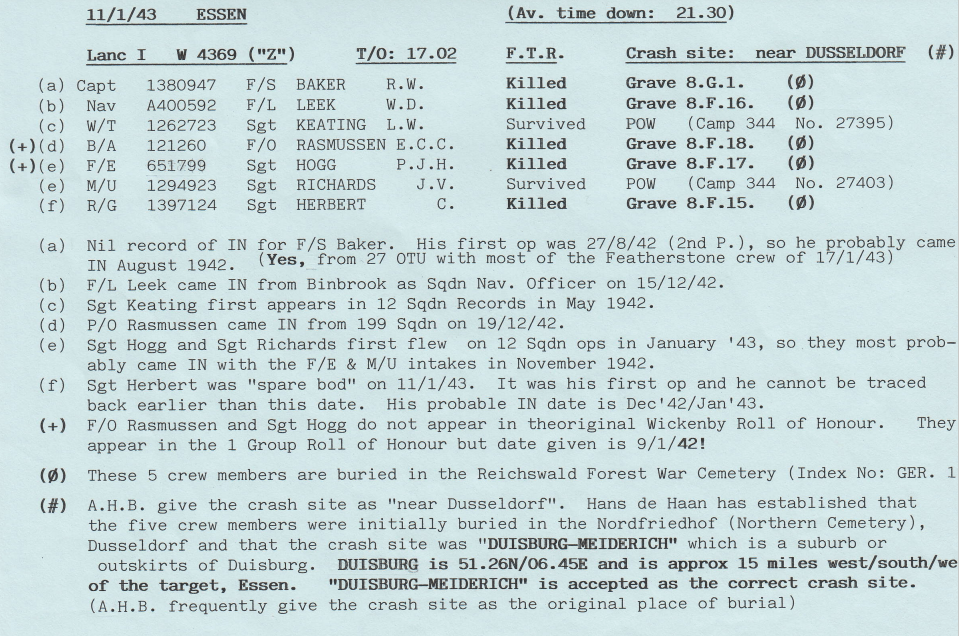
11/1/43 ESSEN – 8 a/c F/S BAKER F.T.R.
12/1/43 ESSEN – 7 a/c nil casualties reported
l3/l/43 ESSEN – 3 a/c ni1 casualties reported (Sgt Atwood and crew were on temporary attachment to 103 Sqn and FTR from this operation. Casualty action was taken by 103 Sqn)
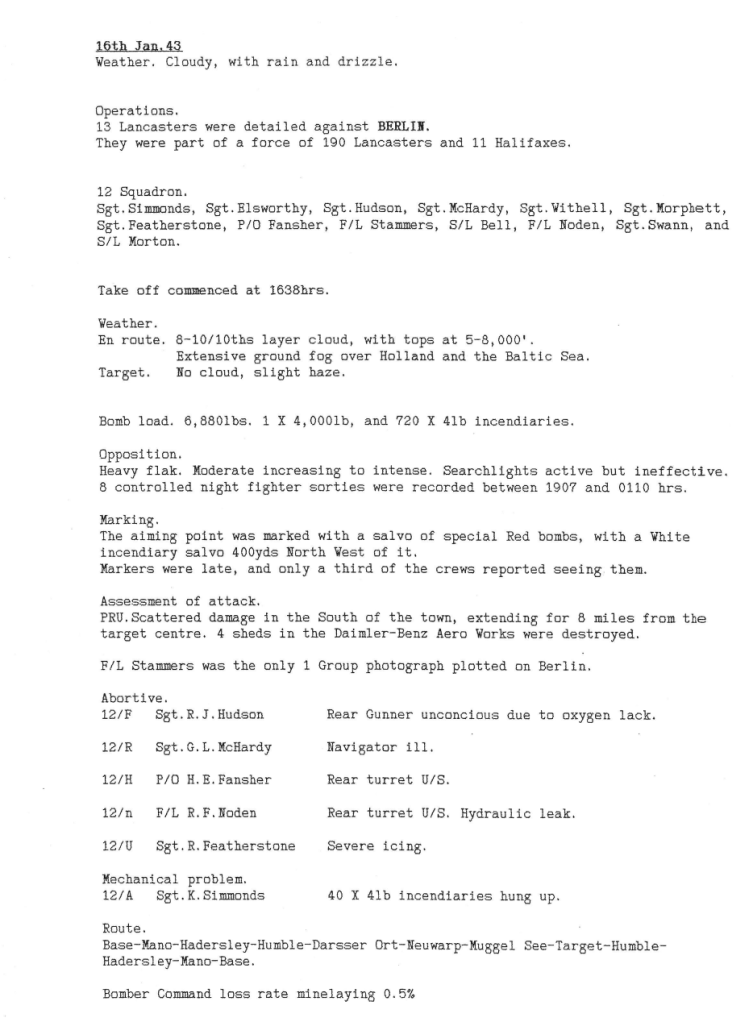
16/1/43 BERLIN – 13 a/c nil casualties reported
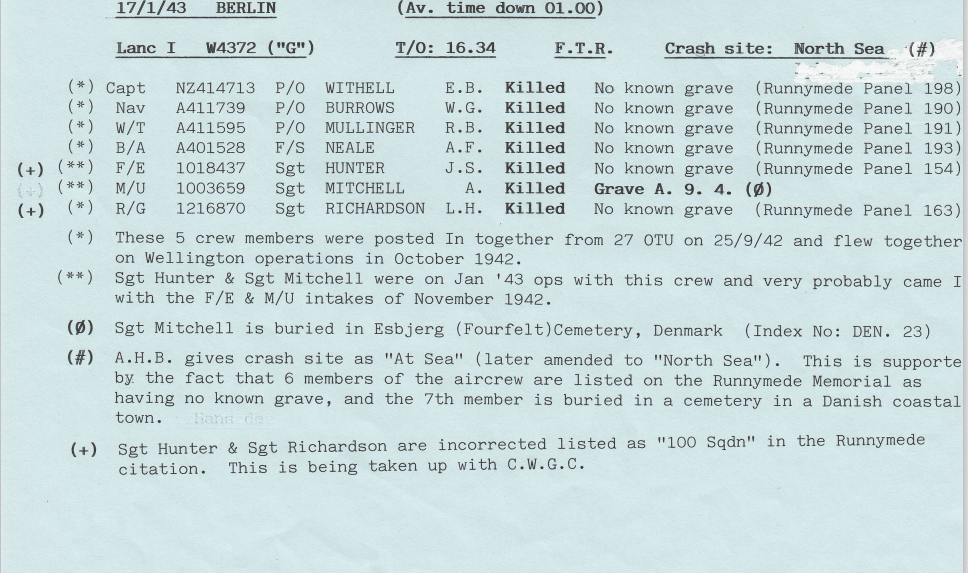
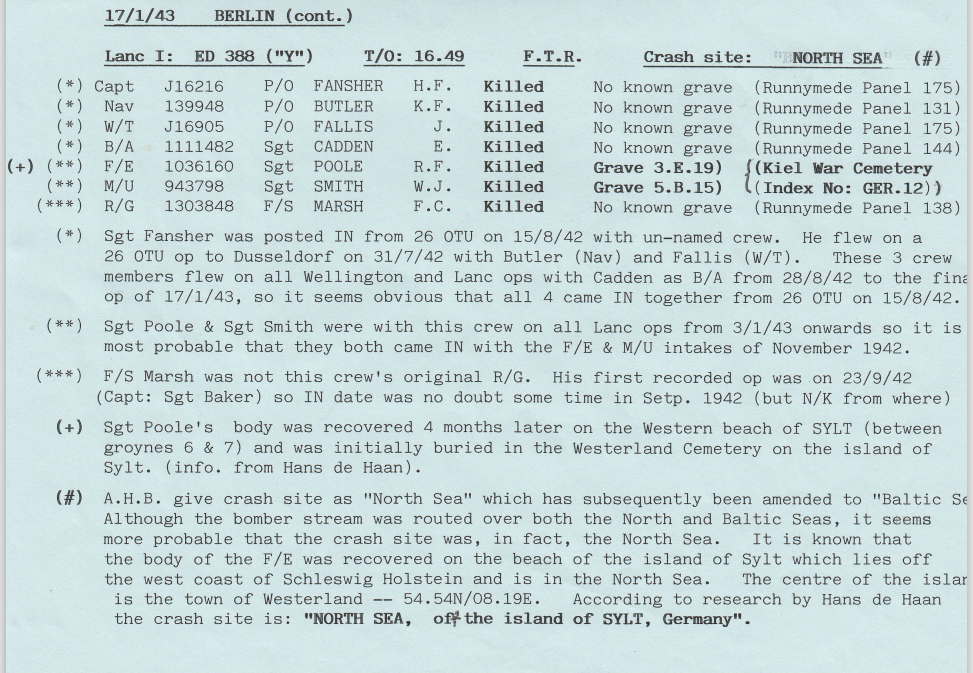
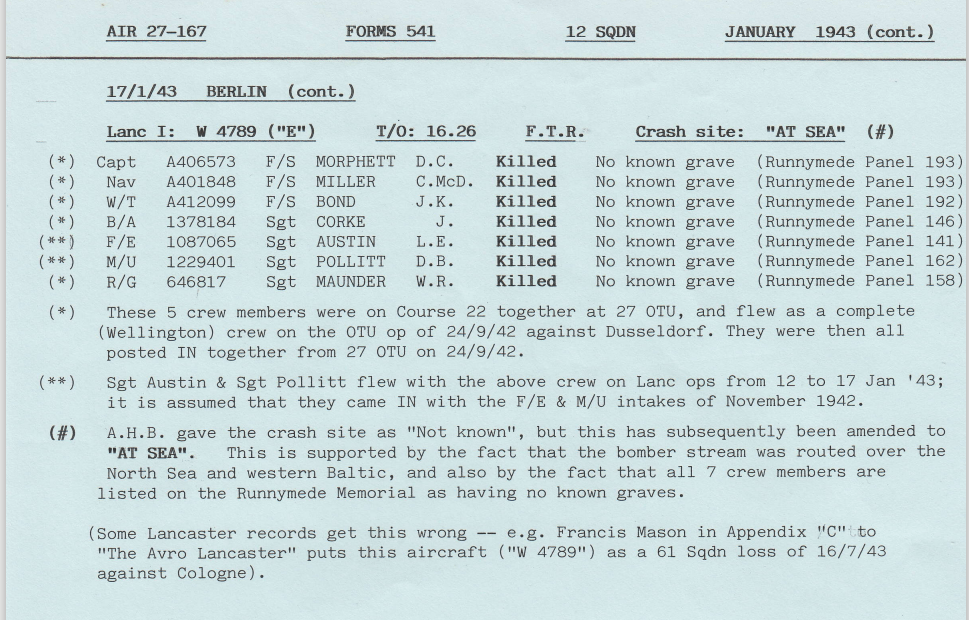
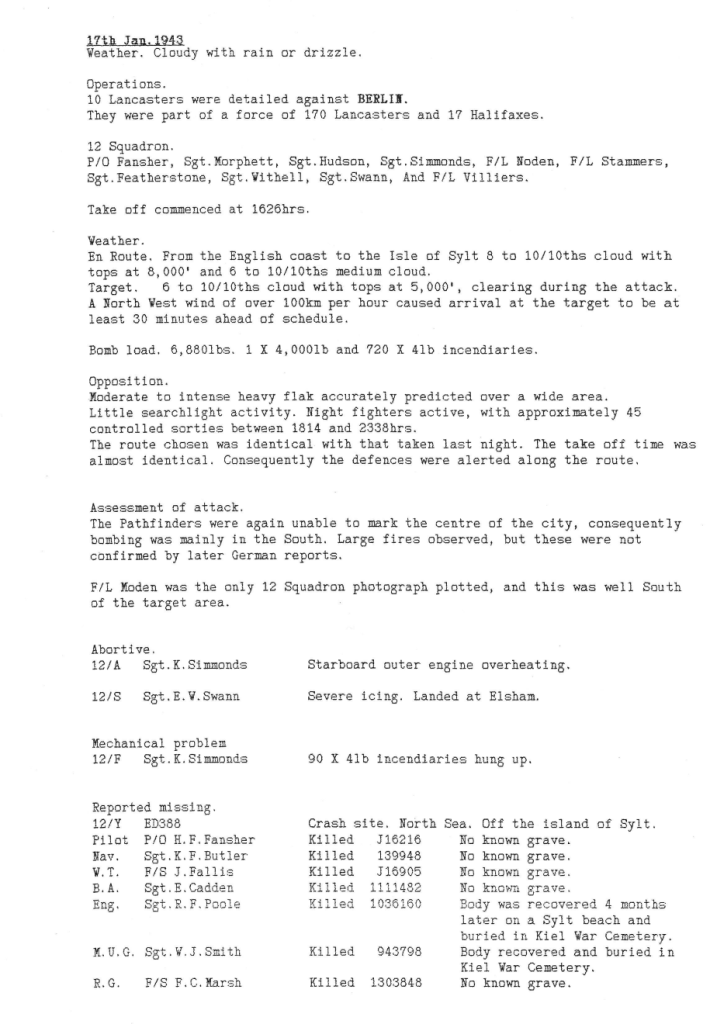
17/1/43 BERLIN – l0 a/c – FOUR AIRCRAFT WERE REPORTED MISSING:- Sgt WITHELL: Sgt FEATHERSTONE; F/S MORPHETT: P/O FANSHER
FTR = Failed to Return
a/c = aircraft
Extract from 12 Sqn Operational Record Book Appendix
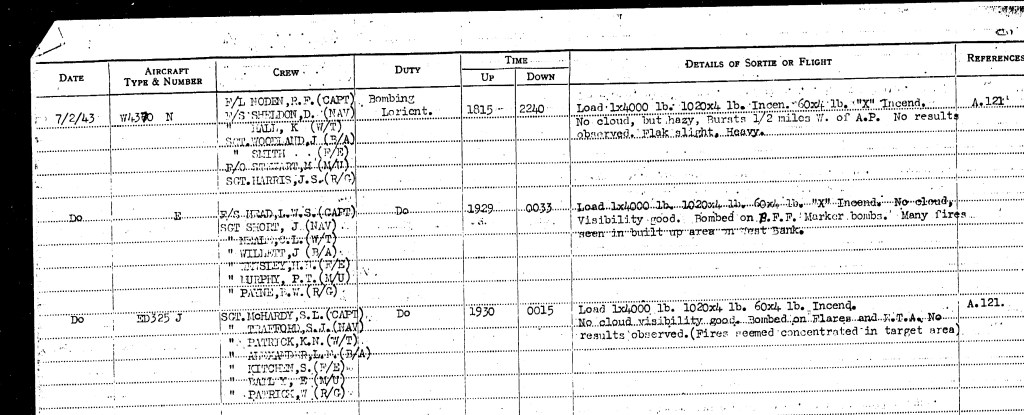
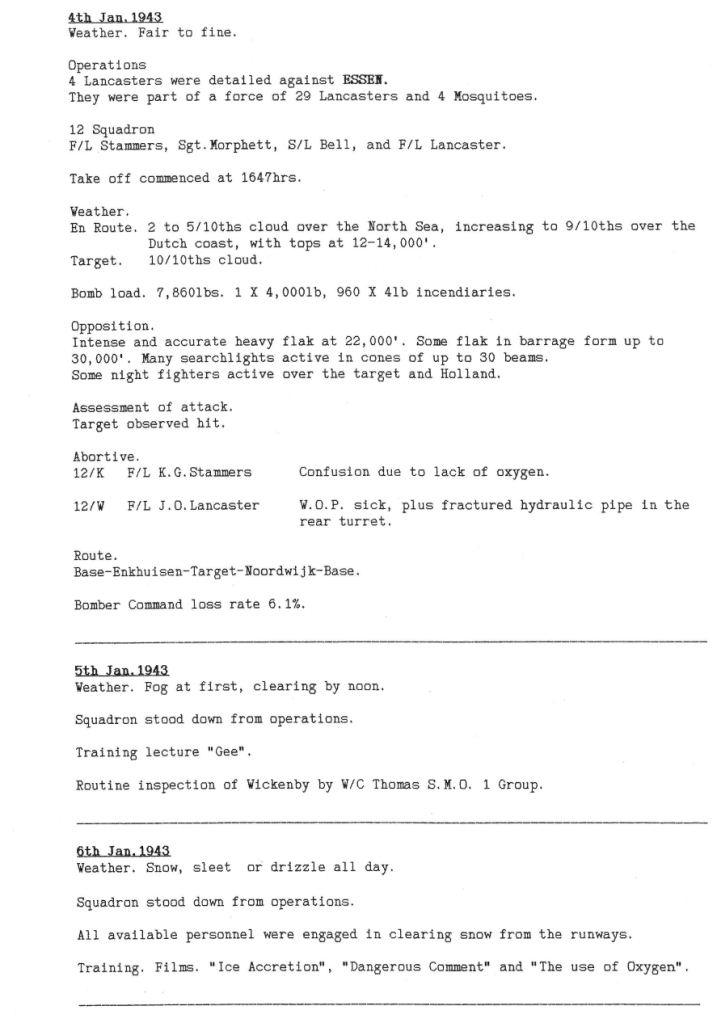
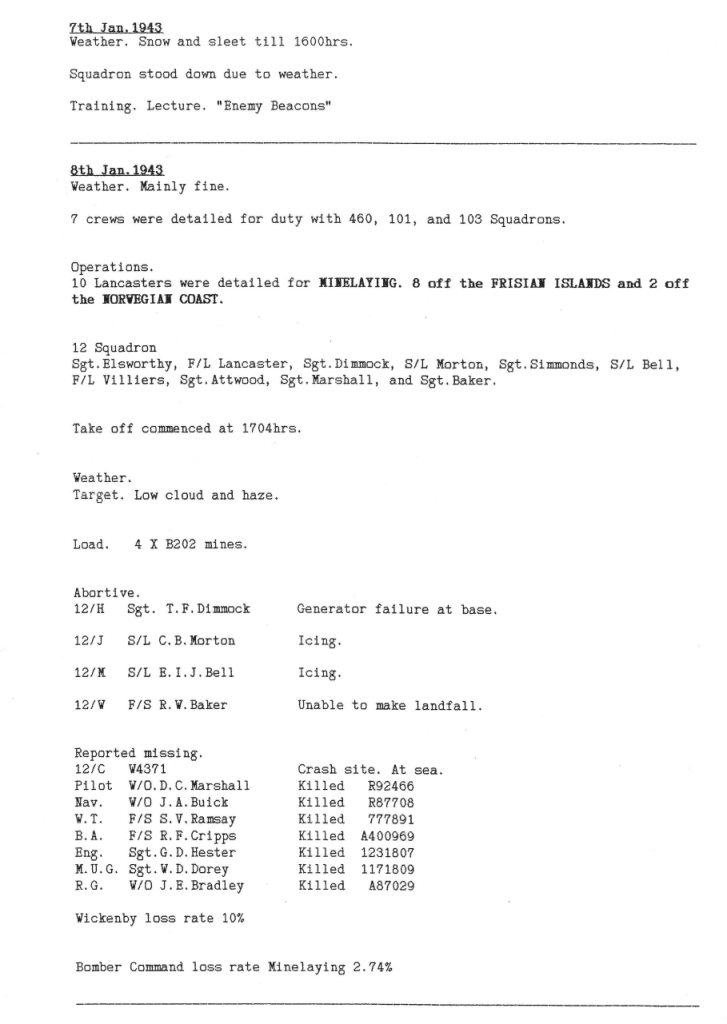
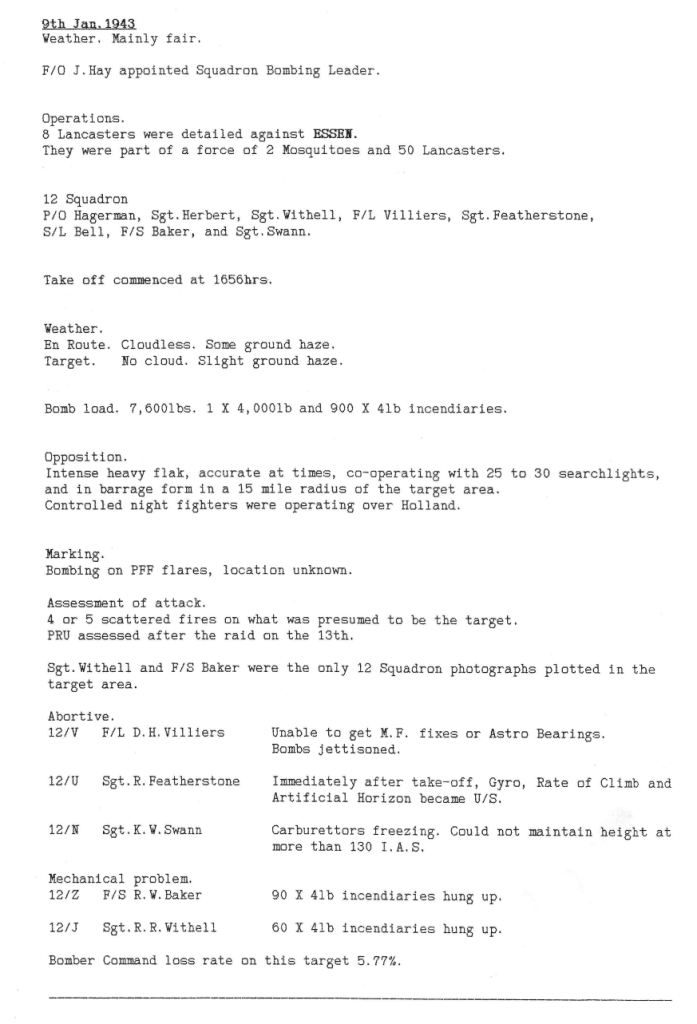
The following information is taken from the Operational Record Book (RAF F 540) completed immediately after missions – the notes at the end were added later by members of the Wickenby Register:
2nd P = Second pilot – it was normal for a new pilot to fly a mission with an experienced crew prior to flying with his own crew
A.H.B. = Air Historical Branch
Flight Sergeant Baker had completed 12 missions flying Wellingtons and this was his 3rd in a Lancaster. He was 21, unmarried and came from Harold Wood in Essex.
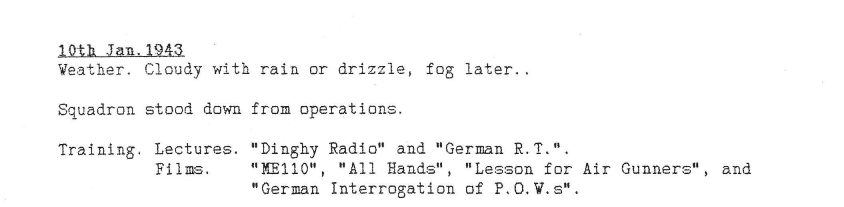
12 Sqn Diary – 11 Jan 43
Extract from 12 Sqn Operational Record Book Appendix (RAF F541)
Flight Sergeant Frederick Cecil Marsh (left), the Rear Gunner in PO Fansher’s aircraft – killed on night of 17/18 Jan 43. He was on attachment from 100 Sqn. He was 34 and came from Christchurch, Hampshire
Flight Sergeant Miller RAAF, was a graduate of Melbourne University.
From November 1942 to January 1943, 12 Squadron had spent much of their time converting from Wellington bombers to Lancaster bombers and the missions below were some of the first flying the new type. They were the first squadron in 1 Group to convert.
These were typical missions for this period of the Second World War; La Rochelle was a large U-Boat base for the Germans and the HQ of their Naval Atlantic Command; Essen is in the Ruhr and was a major manufacturing base; Gardening was the euphemism for anti-shipping mine-laying, mostly on the coast of occupied Europe; the mines were known as “vegetables” by the RAF.
If an aircraft was lost or missing, it was the custom to only refer to the captain when describing losses, hence below it says “Sgt Marshall F.T.R.” although there were 6 other crew members:
Pilot (almost always the captain of the aircraft, regardless of rank)
All of the information in the next section is taken from the Appendix to the Operational Record Book (RAF Form 541) compiled by 12 Sqn immediately after each mission. The further details recorded at the end were collated after the war by members of the Wickenby Register from information in the National Archives, the Public Records Office and from aircrew recollections. The Wickenby Register was an affiliation of ex-aircrew who served at Wickenby on 12 and 626 Squadrons – they had regular get-togethers at Wickenby every September until 2017, were responsible for the Icarus Memorial at the main entrance and issued a monthly newsletter.
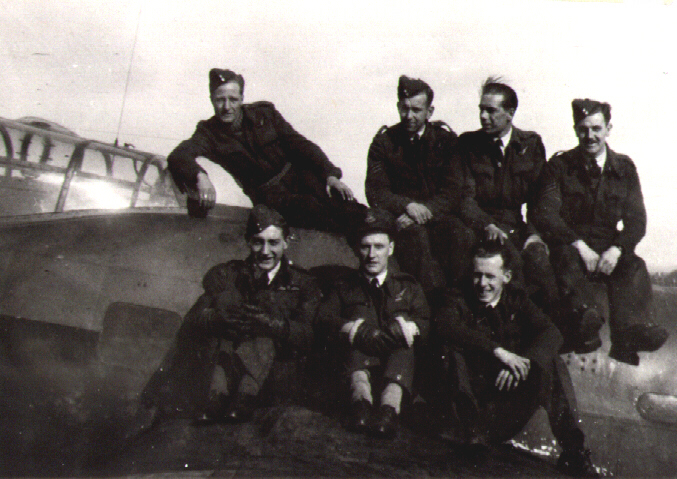
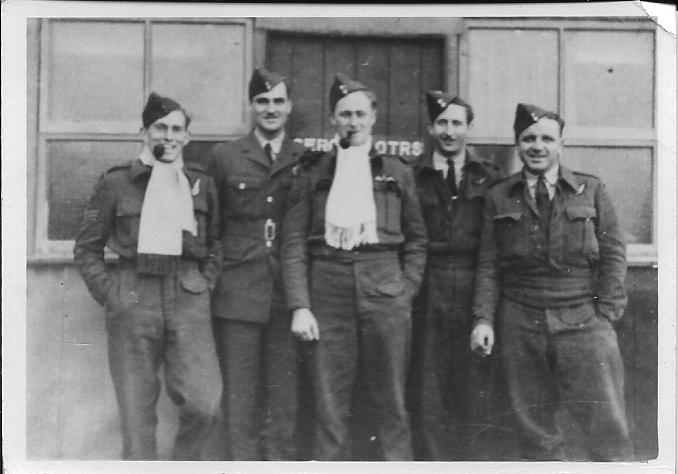
Warrant Officer Marshall (centre) and 4 members of his crew. Warrant Officer John Buick, the Navigator is second left. All were killed on the night of 8/9 January 1943.
Warrant Officer John Buick, a Canadian, as was his pilot and 2 other crew members, became friendly with a local family from Market Rasen and the whole crew were invited to Christmas dinner 2 weeks before they were killed. Sgt Ramsay was from Halfway House , Transvaal, South Africa. This was the first crew to be reported missing, since the Squadron’s conversions to Lancasters.










 RAF Wickenby - This week in history - World War 2